


PEACE JUSTICE AND STRONG INSTITUTIONS
Promote peaceful and inclusive societies for sustainable development, provide access to justice for all and build effective, accountable and inclusive institutions at all levels.
490
ACTION GOALS
341
PUBLICATIONS

EXPERTS

Ubaidillah Nugraha, M.Ec., M.P.M.
Related Goals
Dr. Ridho Bramulya Ikhsan, S.E., M.M
Related Goals


BINUS University ensures that local stakeholders—including industry representatives, local government, civil society, and partner institutions—have a meaningful mechanism to participate in university decision-making. This involvement is formalized through advisory boards, partnership programs, and collaborative forums that directly influence BINUS’s academic direction, research focus, and community initiatives.

Through these advisory structures, BINUS institutionalizes stakeholder input into formal decision-making processes, ensuring that external perspectives are systematically integrated into academic and operational governance.

  1. Advisory Boards and Stakeholder Participation

The BINUS Advisory Board serves as a strategic governance platform that brings together representatives from industry, government agencies, academia, and professional associations. Each school and faculty—such as the BINUS Business School, School of Computer Science, and School of Civil Engineering—has its own Advisory Board responsible for providing guidance on academic relevance, curriculum design, graduate employability, and institutional reputation.

  1. Curriculum Development with Local Stakeholders

On 27–28 February 2025, BINUS University held a Focus Group Discussion (FGD) at BINUS Square to gather input for the development of its proposed Master of Law program, focusing on business law. The discussion involved a diverse group of stakeholders, including academics from other Indonesian universities, a representative from the Indonesian Attorney General’s Office, a former Supreme Court justice, and a representative of the Indonesian Advocates Association (PERADI), alongside BINUS academics and other participants.

These stakeholders provided academic, government, judicial, and legal professional perspectives to inform the proposed curriculum, including its structure, academic requirements, and relevant legal topics.

  1. BINUS Industry Partnership Program (BIPP)

The BINUS Industry Partnership Program (BIPP) provides an ongoing platform for collaboration and dialogue between BINUS University and local and international industry partners. During 18–22 June 2025, BIPP activities provided opportunities for the university and its partners to exchange perspectives on workforce needs, professional competencies, digital transformation, and industry requirements. Through joint discussions, curriculum alignment, and internship programs, industry partners can provide input to help align academic programs with workplace needs and contribute to curriculum development.

  1. Coordination Forum for Advancing Research and Innovation in Semarang

In January 2025, BINUS University reported its participation in the Coordination Forum for Advancing Research and Innovation in Semarang, a forum established under the Mayor of Semarang’s Decree No. 000.9.2/1007 of 2024 for the 2024–2027 term. A BINUS representative was appointed Coordinator for Community Engagement. The forum provides a mechanism for gathering public aspirations to inform research and innovation policy and communicating recommendations to the Mayor of Semarang. Through this role, BINUS participates in a collaborative process connecting community perspectives, research priorities, and local government planning.

  1. Sustainable Island Initiative

On 17–18 July 2025, BINUS University participated in the Sustainable Island Initiative in Panggang and Pramuka Islands, Jakarta. The initiative brought together government institutions, local leaders, community members, and other partners to support sustainable island development. Activities included community training, women’s entrepreneurship workshops, digital marketing and e-commerce training, and a multi-stakeholder forum. These activities provided opportunities for dialogue and collaboration on local development priorities and community-led sustainability initiatives.

  1. Research and Policy Collaboration through RTTO

Through the Research and Technology Transfer Office (RTTO), BINUS University facilitates research collaboration and knowledge exchange with external stakeholders, including government institutions, NGOs, and civil society organizations. This is an ongoing area of engagement intended to address social, economic, technological, and sustainability challenges through research and knowledge transfer. Specific examples and dates of stakeholder activities undertaken during 2025 should be added when supporting documentation is available.

  1. Collaborative Planning with External Stakeholders

On 4 December 2025, Teach For Indonesia (TFI) held a Partner Gathering at BINUS @Kemanggisan, bringing together stakeholders from NGOs, foundations, schools, communities, government institutions, and industry. The gathering provided a forum for partners to exchange knowledge and discuss strategies to strengthen programs, develop new initiatives, and address challenges in the coming year. This engagement created opportunities for cross-sector stakeholders to contribute ideas and perspectives to future program planning.

According to the BINUS Support Portal, BINUS University manages student organizations through a formal framework that outlines the procedures for establishing organizations, their rights and responsibilities, and the leadership election process. This framework enables students to express their ideas and aspirations and participate in organizational decision-making.

The 2025 Inauguration of Student Organization Leaders demonstrated the university’s formal recognition of student organizations and their leadership. The event inaugurated 65 leaders representing 24 Himpunan Mahasiswa Jurusan (HMJ) and 41 Unit Kegiatan Mahasiswa (UKM) for the 2025–2026 period. These organizations provide channels for student representation and participation in academic and non-academic activities.

Union Provides Governance Input to the University

Student organizations at BINUS University provide channels for students to express their aspirations and participate in matters related to campus life. Students can propose the establishment of new organizations, elect their leaders through established election processes, and develop their own organizational work plans and activities. Student organizations submit activity proposals and budgets for university review and approval, while retaining responsibility for implementing their programmes in accordance with the approved plans and budgets. The university monitors implementation to ensure accountability while allowing student organizations to manage their activities within the approved framework.

Student leadership is also supported by a formal leadership regeneration process involving Campus Elections and General Elections (Pemilu Kampus and Pemilu Umum). In addition, BINUS University’s Good Organization Governance (GOG) principles promote participation, transparency, accountability, and responsible organizational management.

Union Provides Support for Students

Student organizations at BINUS University consist of two main categories: Unit Kegiatan Mahasiswa (UKM) and Himpunan Mahasiswa Jurusan (HMJ). Both provide opportunities for students to develop their knowledge, skills, and personal potential beyond the classroom. Some student organizations are specifically established to support students’ learning, skill development, and personal growth.

  1. Unit Kegiatan Mahasiswa (UKM)

UKM provides a platform for students to develop their interests and talents through extracurricular activities. Examples include:

  • Bina Nusantara Computer Club (BNCC): Organizes learning and training programmes, seminars, workshops, and hackathons in information technology to help students improve their technical knowledge and practical skills.
  • BINUS English Club (BNEC): Provides English learning opportunities through TOEFL preparation, debate, public speaking, and conversation classes. It also organizes English competitions to help students improve their language and communication skills.
  • BINUS Square Student Committee (BSSC): Organizes creative and innovative activities to help students living at BINUS Square develop their soft skills and hard skills.
  1. Himpunan Mahasiswa Jurusan (HMJ)

HMJ provides a platform for students at the departmental level to connect, discuss, express their aspirations, and develop their academic and non-academic potential. Examples include:

  • Himpunan Mahasiswa Teknik Informatika (HIMTI): Supports students through its Responsi programme, which provides additional learning sessions to help them understand course materials. HIMTI also organized the HIMTI Bootcamp 2025, offering practical training in artificial intelligence and machine learning to develop students’ technical knowledge and skills.
  • Himpunan Mahasiswa Teknik Industri (HIMTRI): Supports students through its 2025 Temu Keakraban Himpunan programme, which helps new students become familiar with their academic environment, build relationships with fellow students, and learn from senior students’ experiences in university life, internships, and career preparation.

Through these activities, UKM and HMJ help students strengthen their knowledge, develop practical competencies, build social connections, and gain learning experiences beyond their regular academic programmes.

Union Provides Social Activities

BINUS student organizations also organize social and humanitarian activities that allow students to contribute directly to the community. Through volunteering, community service, and educational programmes, students help address community needs while developing empathy and social responsibility.

Examples include:

  • FAST Respond Community (FARCO): Established in 2018, FARCO focuses on first aid and emergency response. Its activities provide opportunities for students to develop emergency response skills and contribute to community safety.
  • Teach For Indonesia Student Community (TFISC): Organizes community programmes that support community development and quality of life. Its Community Development 2025 programme involved interactive activities with elderly residents at Sasana Tresna Werdha RIA Pembangunan, encouraging social interaction and community engagement.
  • HIMME: Through Social Responsibility 2025, students participated in community service at Wisma Karya Bakti orphanage. Activities included cleaning the surroundings, planting trees, and providing essential supplies.

These activities demonstrate how student organizations engage in humanitarian initiatives, environmental action, and community service. Through direct involvement, students contribute to community well-being while developing empathy, cooperation, and social responsibility.

BINUS University has established written policies and institutional procedures to systematically identify and engage with local stakeholders external to the university.
These are formally regulated under Rector’s Decree No. 0136A, which outlines BINUS’s governance framework for collaboration, inclusivity, and external partnerships. The decree sets out the responsibilities of units within the university to manage engagement processes, emphasizing collaboration with stakeholders from industry, government, NGOs, and local communities.

Specifically, Part II, Point n of Rector’s Decree No. 0136A mandates the establishment of the BINUS Collaboration Center as the coordinating body responsible for managing and evaluating institutional partnerships.
This unit plays a central role in:

  • Mapping and identifying local external stakeholders across sectors (industry, government, community organizations),

  • Facilitating engagement and partnership agreements that align with academic, research, and community development priorities, and

  • Monitoring and evaluating collaboration outcomes to ensure mutual benefit and sustainability.

These policy directives are reinforced in BINUS’s Commitment to SDGs Policy document (2023), which explicitly references Decree No. 0136A as the basis for structured collaboration and stakeholder inclusion. The policy highlights the university’s commitment to working with local partners through educational, social, and community development programs.

In practice, the procedures set out in the Decree are implemented through several institutional mechanisms, including:

  • BINUS Collaboration Center – responsible for stakeholder identification, partnership initiation, and relationship management.

  • Advisory Boards – comprising local government officials, industry representatives, and professional associations who provide input to university planning and curriculum development.

  • BINUS Industry Partnership Program (BIPP) – a structured framework for engaging local business partners to align academic outcomes with community and regional needs.

  • Teach for Indonesia (TFI) and Community Development (PKM) – programs that directly involve local communities in education, empowerment, and social innovation activities.

Through these written policies, structural mechanisms, and coordinated procedures, BINUS University ensures a systematic and accountable approach to identifying, engaging, and sustaining relationships with local external stakeholders in support of institutional and societal goals.

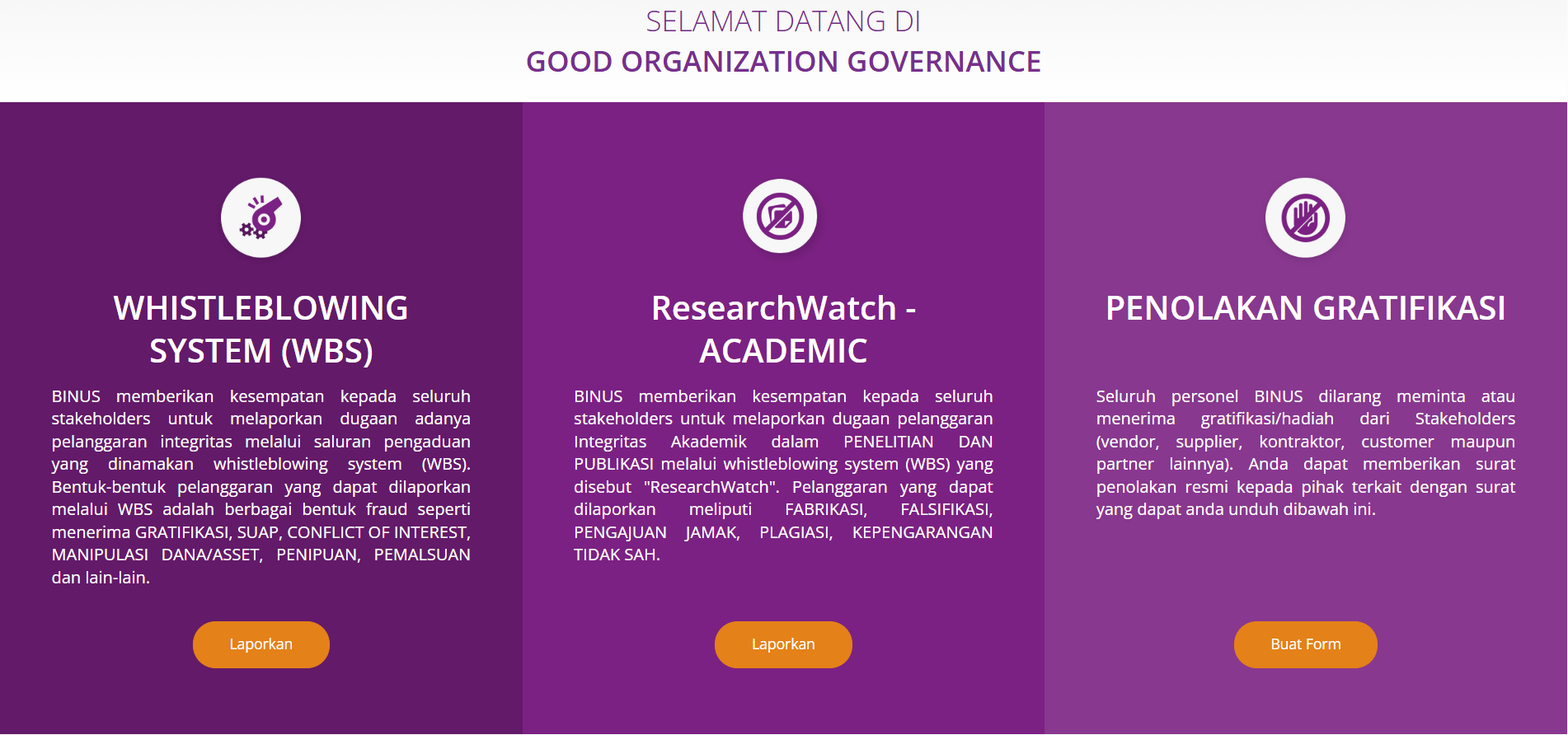
Bina Nusantara (BINUS) University demonstrates its strong commitment to integrity and ethical governance through the implementation of Good Organization Governance (GOG) principles as outlined in the CEO Decree on GOG Implementation and the BINUS Integrity Pact. These documents serve as the university’s formal and written commitments to prevent and combat organized crime, corruption, and bribery within its academic and administrative ecosystem.

Through its Good Organization Governance (GOG) framework, BINUS promotes transparency, accountability, and ethical conduct across all levels of management and operation. This policy regulates behavior in decision-making, ensures fairness in institutional processes, and sets standards to avoid conflicts of interest, misuse of power, or corrupt practices. The official decree defines mechanisms for monitoring compliance and maintaining institutional integrity as part of the university’s governance system.

Complementing this framework, the university enforces the BINUS Integrity Pact, a formal declaration signed by faculty, staff, and leaders, committing them to uphold honesty, reject bribery, and maintain ethical standards in every activity. This pact strengthens BINUS’s zero-tolerance stance on corruption and unethical behavior by embedding integrity as a core institutional value.

In practice, BINUS implements a whistleblowing system that enables the academic community to report violations of integrity, such as the solicitation or acceptance of gifts, conflicts of interest, or fraud. This system provides a safe and structured channel for addressing unethical practices, ensuring accountability at every level.

Additionally, through the Research Watch and Academic Integrity Policy, BINUS actively prevents and penalizes academic misconduct, including plagiarism, document falsification, collusion, and nepotism. This initiative not only maintains the credibility of research and publications but also reinforces BINUS’s ethical standards in academia.

The university’s dedication to these principles is further demonstrated in its public campaign “Jangan Nyontek!” (Don’t Cheat!), which educates students about the importance of integrity and honesty in academic life. BINUS consistently reminds its community that violations of ethical conduct—such as cheating or falsifying documents—can lead to severe consequences, including expulsion or degree revocation.

Through these integrated policies and educational initiatives, BINUS University exemplifies its institutional commitment to fostering a transparent, ethical, and corruption-free environment in alignment with international standards of good governance.

BINUS University upholds a system of elected representation, ensuring that both faculty and students have a voice in the university’s governance. The key features of the representative governance structure at BINUS University are outlined below:

  1. University Academic Senate: The elected University Academic Senate represents faculty members. It ensures that professors can share their opinions on important academic issues, such as curriculum development and policies. This involvement promotes collaboration and transparency in decision-making.
  2. Student Organizations: Students can elect leaders for various student organizations. These leaders act as representatives, voicing student needs and concerns to the university administration. By participating in these organizations, students can engage in leadership roles, organize events, and advocate for their interests.
  3. Employee Communities: BINUS University also supports employee communities to promote staff interests. For example, the Kolintang Community consists of employees who enjoy playing the Kolintang, a traditional Indonesian musical instrument. This community fosters cultural appreciation and teamwork among staff.
    Importance of Representation

These elected bodies and communities ensure that all voices are heard at BINUS University. By allowing faculty, students, and staff to express their needs and interests, the university promotes a sense of belonging and engagement.