BINUS University has consistently demonstrated its commitment to community empowerment by organizing various training programs and initiatives that directly improve access to essential services such as health, sanitation, and digital literacy. These efforts reflect a comprehensive approach that blends practical action with academic research to support communities, particularly those in underserved areas.
Stunting Reduction Program in Serdang Bedagai
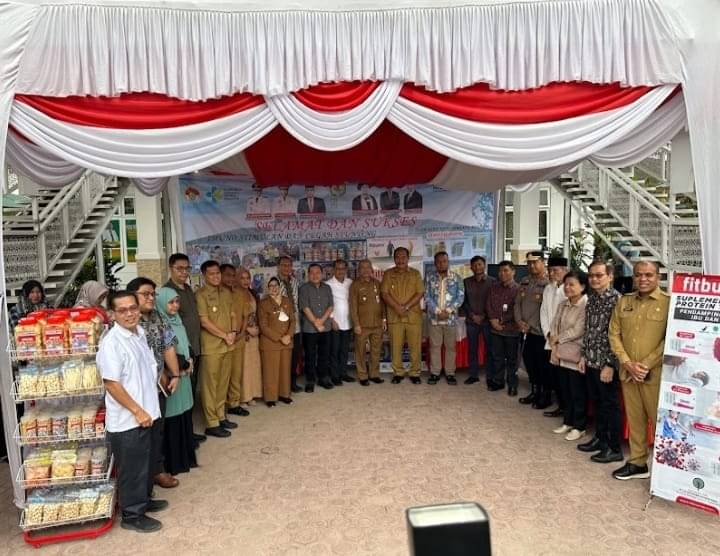
One of the most significant health-related initiatives was a collaborative program to reduce stunting in Serdang Bedagai Regency, North Sumatra. In partnership with the Serdang Bedagai local government, Universitas Sumatera Utara (USU), and PT Mega Medica Pharmaceuticals (MMP), BINUS University helped design and execute a six-month stunting intervention covering 243 villages, 6 urban wards, and 20 community health clinics (puskesmas).
This intervention involved two main components: nutritional support and data-driven monitoring. Children who were identified as at risk of stunting received a specially formulated syrup made from local ingredients such as fish extract (ikan gabus), temulawak, and meniran. This was accompanied by the use of a digital platform called StuntingDB, which allowed health workers to record and analyze child growth data, ensuring the intervention’s effectiveness could be properly tracked.
As a result of this program, local authorities reported a decrease in stunting prevalence, along with improved appetite, weight, and height among participating children. The program serves as a strong example of how academic institutions like BINUS can contribute to solving complex public health issues through coordinated, multi-sector collaboration.
Community Waste Management and Sanitation Training in West Jakarta
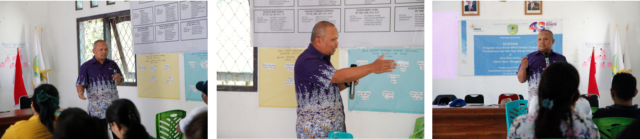
In an urban context, BINUS University supported efforts to improve sanitation through a community waste management program in Taman Alfa Indah, West Jakarta. This program engaged local residents in both education and action, with the goal of increasing awareness, responsibility, and participation in maintaining a clean living environment.
The initiative began with training sessions on how to conduct satisfaction surveys regarding local waste collection services. These surveys helped residents communicate their needs and concerns more effectively to service providers and neighborhood administrators. In addition, BINUS provided hands-on workshops about waste segregation at the household level, teaching participants to properly sort organic, recyclable, and non-recyclable waste.
Research on Sanitation Infrastructure in Ciamis
In addition to its fieldwork, BINUS University also engages in academic research that supports improved access to basic services. One such study, published in the EMACS Journal, examined the condition and management of sanitation infrastructure in Ciamis Regency, West Java. The paper, titled “Study of Sanitation Infrastructure Operations,” assessed 63 MCK (public bathing, washing, and toilet) facilities across 62 villages.
The research revealed that while many units remained operational, others had deteriorated or were not being used optimally. The study highlighted the importance of community involvement in the maintenance of sanitation infrastructure and recommended mechanisms for local contributions to promote sustainability.
By producing and publishing research on community sanitation issues, BINUS contributes knowledge that can influence policy, strengthen local governance, and inform future programs across the country.
Through targeted health interventions, sanitation training, rural digital empowerment, and academic research, BINUS University continues to play an active and meaningful role in improving access to basic services for all. These initiatives demonstrate a university-wide commitment to inclusive development, showing how higher education institutions can serve as agents of change for both urban and rural communities. By combining community engagement with evidence-based strategies, BINUS helps ensure that essential services become more accessible, equitable, and sustainable for everyone.