Designers & the Rise of Al: A Collaboration, Not a Competition
Designers & the Rise of Al: A Collaboration, Not a Competition
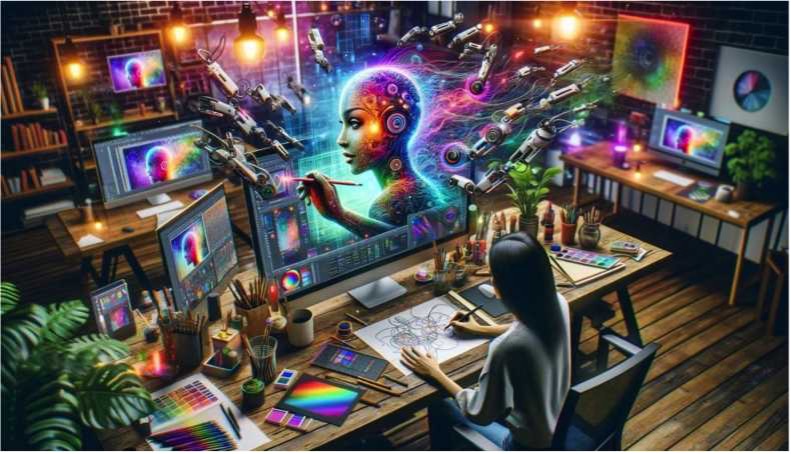
We’re deep into what some call the fourth wave of the Information Age—a time defined not just by digital access, but by intelligent systems that adapt, learn, and even create. For graphic designers, this is both revolutionary and slightly disorienting. Artificial Intelligence (Al) is no longer just a backend automation tool—it’s now sitting beside us in the creative studio, offering suggestions, generating mockups, and, sometimes, even sparking new ideas.
But let’s get one thing clear: Al isn’t here to replace graphic designers. It’s here to reshape the role.
In the past, design tools followed commands. You clicked, dragged, drew, and adjusted. Now, with Al embedded in tools like Adobe Firefly, Figma’s Al plugins, and platforms like Midjourney or RunwayML, we can generate entire design systems from a few typed prompts. Need three logo options in the style of 1950s jazz album covers with a futuristic twist? Type it, and it appears.
That shift—from manual to generative—frees designers from some of the most time-consuming parts of the job. No more starting from a blank canvas. No more hours spent searching for the “right” reference image or color palette. Al can quickly generate moodboards, layout ideas, or alternate compositions in seconds.
But here’s where the nuance lies: while Al is fast and often impressive, it’s not aware. It doesn’t understand the cultural weight of a color in a certain region. It can’t intuitively feel when a design hits the emotional tone of a brand. That’s still the designer’s role—to interpret, refine, and direct.
Designers as Creative Directors
With Al handling more of the execution, designers are shifting toward roles that resemble creative directors—even if they’re working solo. It’s about asking better questions, crafting better prompts, and curating results. The eye becomes more important than the hand. You’re no longer just the maker; you’re the decision-maker.
This shift also means designers need new skills. Prompt engineering—once a fringe concept—is becoming a valuable creative asset. Knowing how to “speak” to an Al model to get your vision across is becoming just as important as knowing how to use a pen tool.
With power comes new responsibility. Al doesn’t always create from scratch—it pulls from vast pools of training data, some of which include copyrighted or culturally sensitive materials. Designers now have to be more aware of where their tools get their inspiration. Are we unintentionally plagiarizing? Are we replicating biases? Is that logo genuinely ours? Some studios are taking clear stances. Others are exploring how to integrate Al ethically—crediting co-created work, disclosing Al-assisted processes, or even building their own smaller, more transparent training sets. As Al becomes embedded in the pipeline, discussions around authorship, originality, and transparency will only grow louder. A Real-World Glimpse: Erica Jung’s Studio
One of the most interesting examples of Al-human collaboration comes from designer Erica Jung, who runs a small experimental design lab in Brooklyn. Her studio uses Midjourney and Adobe Firefly to generate base compositions, which are then refined manually in Illustrator and After Effects.
“The Al gives us texture, unexpected color choices, or a surprising shape language,” Jung explains. “But the final decisions? Those are always ours. We treat Al like an intern—brilliant, fast, but a little naive.”
Her team recently created a visual identity for an indie music festival that used Al-generated plant structures as typography containers. The results were organic, strange, and deeply memorable. “We couldn’t have imagined it on our own,” she adds, “but we knew what to do with it once it showed up.”
Looking Forward: Partnership Over Panic
The fear of being replaced by machines is not new. Photographers felt it when digital cameras arrived. Illustrators felt it when vector graphics took over. Now, graphic designers are facing their own version of that anxiety. But if history has taught us anything, it’s this: tools change, but the creative voice adapts.
Al is a powerful new collaborator. It doesn’t feel, dream, or understand—but it can surprise, assist, and accelerate. The most successful designers in this new age won’t be the ones who resist the tech. They’ll be the ones who treat it like a partner—and remember that meaning still comes from the human side of the screen.