The Age of Information 4: The Digital and Beyond – A graphic Designer’s playground
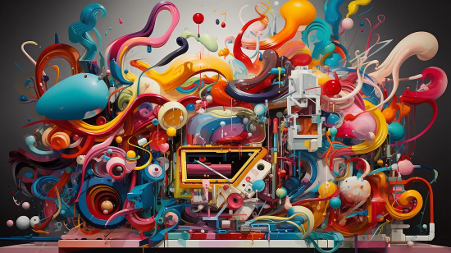
Welcome to the fourth wave of the information Age—where reality is pixelated, algorithms are creative collaborators, and the boundary between human and machine creativity becomes increasingly fluid. We’ve come a long way since the desktop publishing boom of the ‘80s and the pixelated web of the early 2000s. Today, design lives in a hyper-connected, highly personalized, and ever-evolving digital world. This is The Digital and Beyond—a thrilling, challenging playground for graphic designers and visual thinker alike.
From Canvas to Code: The Evolution of Design
In the past, design was primarily about aesthetic. Today, it’s about crafting experiences—fluid, accessible, and emotionally resonant. Designers are no longer limited to static outputs; the now operate across dynamic platforms and interactive environments.
Tools like Adobe Creative Cloud still serve as industry standards, but they’re now accompanied by AI-powered platforms like Figma’s Autolayout, Canva’s Magic Design, and generative engines to focus more on strategy and storytelling.
In this era, design is no longer just what you see—it’s what you feel and how you interact with it.
AI: Threat or Creative Partner?
Revolutionising creativity: AI in graphic design – Foraus
AI tools like ChatGPT, Midjourney, and RunwayML are revolutionizing the design process. Need a mood board in minutes? AI can do that. Want 30 logo concepts by lunch? Just prompt and go.
Understandably, some designers are worried. But here’s the truth: AI won’t replace great designers—it will replace repetitive tasks. The ones who click buttons? Maybe. But the ones who tell stories, who empathize with users, who shape culture? They’re not going anywhere.
AI is best seen as a collaborator—an incredibly fast, slightly unpredictable intern. It helps with ideation and production, freeing up human designers to focus on what they do best: bringing meaning, emotion, and nuance to their work.
Design Trends: Between Chaos and Clarity
Visually, the current landscape is a fascinating mix of contradictions.
On one end of the spectrum, we have a resurgence of brutalism and anti-design—bold, raw, and unapologetically chaotic. On the other, there’s a calming pull toward soft gradients, accessible typography, and minimalist interfaces focused on well-being.
There’s a constant push and pull between maximalist nostalgia (think Y2K, glitchcore, 3D chrome) and calm clarity (neobrutalism, muted tones, clean UX). Brands want to feel fresh yet familiar, bold yet reliable.
Studios like &Walsh, COLLINS, and Ordinary Folk are at the forefront of this evolution—blending storytelling, motion, and emotion into digital experiences that resonate. Meanwhile, independent designers are thriving on platforms like Behance and Dribbble, turning personal creativity into global conversations.
The Future: Fluid, Cross-Disciplinary, and Purpose-Driven
So, what’s next?
Design will become even more interdisciplinary—merging with psychology, sustainability, AI ethics, and behavioral science. It will expand into new spaces: spatial computing, VR/AR environments, and even neural-responsive interfaces.
But one thing will remain unchanged: design is about people. About how they feel, move, and connect. Whether it’s a micro-interaction on a website or an immersive digital campaign, great design elevates human experience.