



Implementation of Artificial Intelligence (AI) and Cloud Computing in Cultural Tourism
Background
Advancements in digital technology have significantly transformed the cultural tourism sector. Artificial Intelligence (AI), Internet of Things (IoT), big data, and cloud computing are increasingly used to enhance tourism services, improve destination management, and support sustainable development. The Indonesian government has actively encouraged AI adoption in both cultural and tourism sectors as part of national digital transformation efforts. [antaranews.com]
Global tourism trends also indicate a shift toward personalized, high‑quality travel experiences supported by digital technologies. The integration of AI has become essential in meeting these evolving expectations, enabling more customized, localized, and efficient cultural tourism services. [trendsetter.id]
- The Role of AI in Cultural Tourism
AI plays a crucial role in modernizing cultural tourism by enhancing visitor experience and facilitating the preservation and dissemination of cultural heritage.
Key applications include:
- Chatbots and virtual assistants providing 24/7 multilingual tourist support and personalized recommendations. [idebiz.id]
- Intelligent recommendation systems that analyze user preferences and travel patterns.
- Automation in tourism operations such as hotel check-in, ticketing, and customer service.
In the cultural domain, AI technologies have evolved beyond simple automation to communicate cultural meaning more authentically. Conceptual models such as Deep Cultural Knowledge Integration (DCKI), Cultural-Semantic Discourse Interaction (CSDI), and the AI Cultural Transparency Framework (AICTF) establish guidelines for ethically integrating cultural knowledge into AI systems and ensuring culturally sensitive digital communication. [zenodo.org]
- The Role of Cloud Computing in Digital Tourism
Cloud computing serves as a foundational infrastructure for modern tourism ecosystems by enabling large-scale cultural data storage, analytics, and system integration.
Its functions include:
- Providing scalable storage for digital cultural archives.
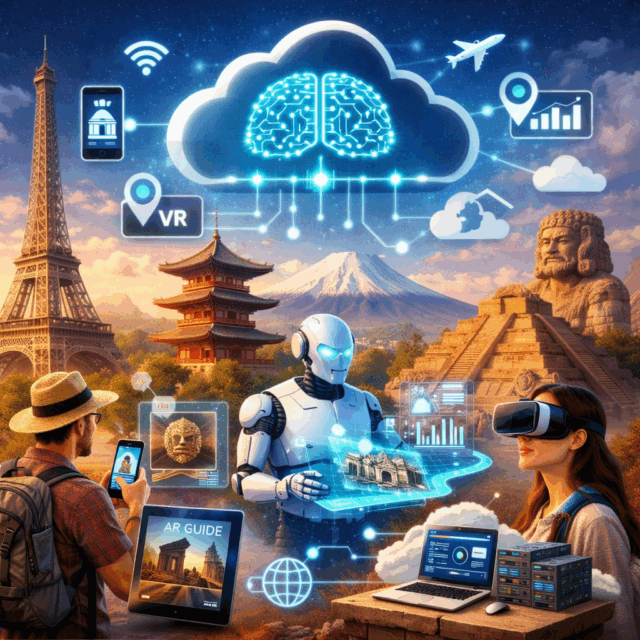
- Supporting augmented/virtual reality (AR/VR), allowing virtual access to museums, temples, and historical sites.
- Integrating IoT-based smart tourism systems such as visitor capacity sensors and smart ticketing.
- Enabling big data analysis for strategic tourism planning.
Studies on Indonesia’s digital tourism advancements show increasing adoption of VR tours, AR museum guidance, AI-driven itinerary tools, IoT systems, and cloud-backed digital platforms across cultural destinations. [bukaportal.com]
- Improving Cultural Tourism Management Through Technology
AI and cloud computing contribute to better management of cultural tourism in various ways:
- Visitor flow prediction, reducing congestion and preventing overtourism.
- Efficient destination management using big data forecasting and sensor networks.
- Interactive cultural storytelling delivered through AI, AR, and VR technologies.
- Data-driven promotion enabled by cloud-based analytics.
Academic and industry discussions, such as those presented during the National Tourism Conference 2025, highlight digital transformation—especially AI and ICT—as a core component of sustainable tourism development and tourism education. [journal.pubfine.com]
- Challenges in Implementing AI and Cloud Computing
Despite the benefits, several challenges remain:
- Uneven digital connectivity, particularly in remote cultural sites. [antaranews.com]
- Ethical concerns, especially regarding accurate representation of cultural values.
- Insufficient digital literacy, requiring stronger training and educational programs in tourism communities.
- Regulatory gaps, including AI ethics, safety, and data governance. [antaranews.com]
Conclusion
The integration of Artificial Intelligence and cloud computing in cultural tourism offers significant opportunities to strengthen personalization, operational efficiency, and cultural preservation. AI enhances visitor engagement through intelligent recommendations and interactive storytelling, while cloud computing provides the infrastructure necessary for digital archives, AR/VR experiences, smart tourism systems, and big data analytics.
However, successful implementation requires addressing challenges related to infrastructure, ethics, regulation, and human resource capacity. With proper support, AI and cloud technologies can help cultural tourism grow in a more sustainable, innovative, and globally competitive direction.
References
- Indonesia Tourism Outlook 2025 – Integration of AI in tourism. [trendsetter.id]
- ANTARA News – AI initiatives in cultural and tourism sectors. [antaranews.com]
- IDEBIZ – AI trends in tourism 2025. [idebiz.id]
- Nurhidayati et al. – AI and Cultural Communication theoretical frameworks. [zenodo.org]
- BukaPortal – Digital Tourism Indonesia 2025 (VR/AR/IoT). [bukaportal.com]
- National Tourism Conference Proceedings – AI and ICT in tourism innovation. [journal.pubfine.com]
Comments :