

Technology Used Career Clarity: BINUS Commercializes Career Pathway App
A five-minute interest test built through community service by the Creativepreneurship Department at BINUS @Bandung is now registered intellectual property, formally handed over to its first partner school, and assessed as ready for commercial rollout.
Every year, more than a million Indonesian high school graduates choose a study program. Many choose wrong. An Indonesia Career Center Network (ICCN) survey found that 87% of Indonesian university students feel their major does not match their interests. International research links that kind of mismatch to lower performance and higher dropout rates.
Career Pathway Apps was built to catch the mismatch before enrollment, not after. The application was created by Dr. Doni Purnama Alam, S.Kom., M.M., Head of the Creativepreneurship Department at BINUS @Bandung, together with Riecky Syarief Poerwadiredja. It started as a community-service tool and has grown into a product BINUS can now offer to schools at scale.
Rooted in community service
Career Pathway reached its first students through BINUS community service (Pengabdian kepada Masyarakat), not through a sales campaign.
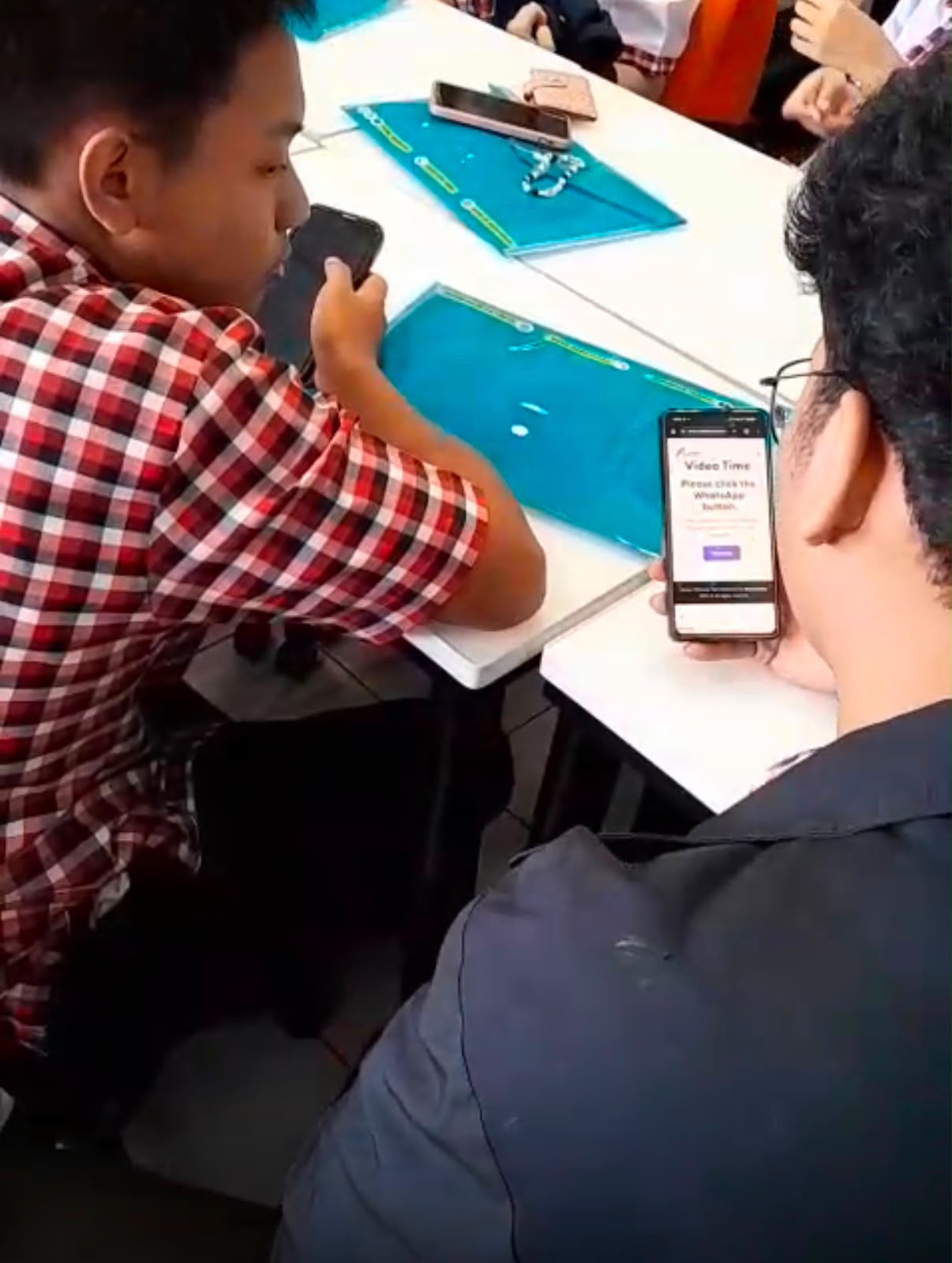
A student works through the Career Pathway test on a phone during a session.
The sessions also travelled beyond the first school. Word spread from school to school without paid promotion, and responses arrived from schools in more than 45 cities.
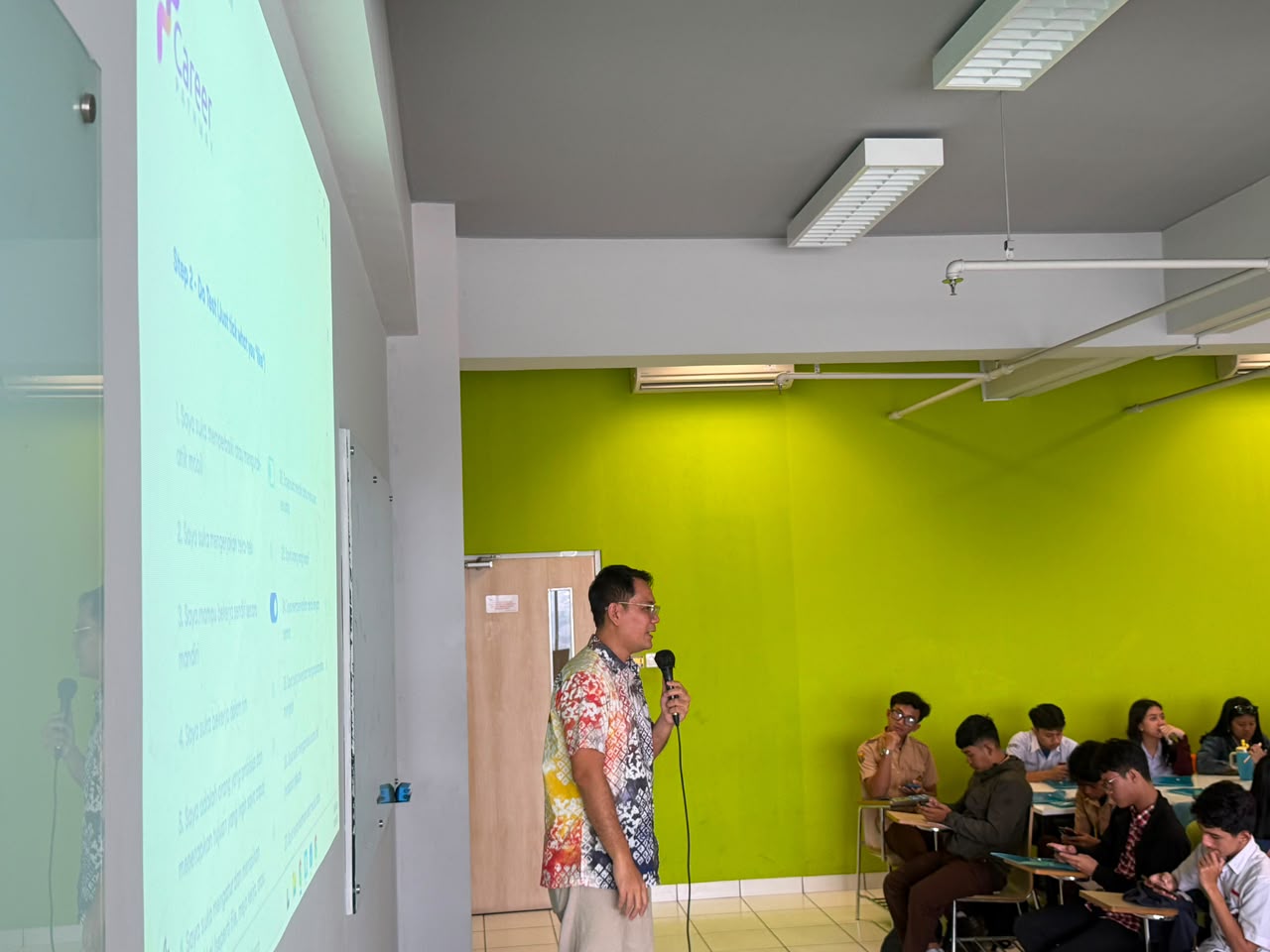
Dr. Doni Purnama Alam (Head of Department of Creativepreneurship) present the career pathway app multi-school across 45 cities in Indonesia.
In 2026, Dr. Doni’s team ran a Career Pathway trial class program for students as representative Ms. Kania Alma Tiara, S.M., M.Kom presented at SMA Santa Maria 3 Cimahi. Students took the test in class, and the team presented what their RIASEC results mean for choosing a program. Everything was given to the school free of charge:
- access to the Career Pathway app and the Career Pathways video
- trainers, speakers and a guidebook so teachers can run the test themselves
- a mapping of each student’s results, returned to the school
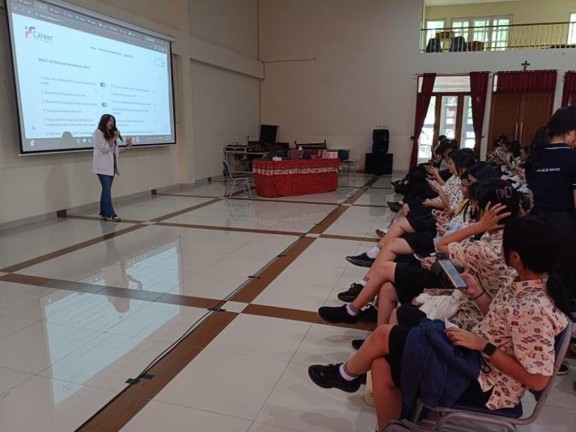
Ms. Kania Alma Tiara (Subject Content Coordinator of Creativepreneurship) present to SMA Santa Maria 3 Cimahi as real partner in this application
Guidance and counseling (BK) teachers are at the heart of the model. The app gives them a quick, structured starting point for conversations about majors. The student mapping helps them see where a class’s interests lie.
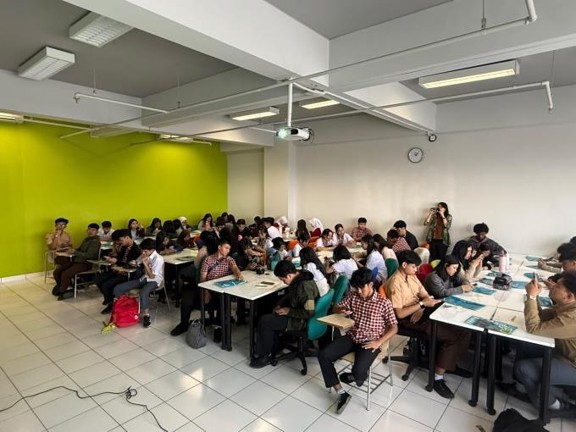
Students follow along during a Career Pathway trial class.
Contributing to the Sustainable Development Goals
Career Pathway supports four of the UN Sustainable Development Goals, led by SDG 4, Quality Education.
| SDG | Target | How Career Pathway contributes |
| SDG 4 Quality Education | 4.3 Equal access to quality tertiary education; 4.4 Skills relevant to employment | Helps students choose a study program that fits their interests, so they are more likely to persist and succeed |
| SDG 8 Decent Work and Economic Growth | 8.6 Fewer young people not in employment, education or training | Addresses the mismatch behind dropout and the 71.7% of workers whose jobs are unrelated to their field (ICCN) |
| SDG 10 Reduced Inequalities | 10.2 Social and economic inclusion for all | Brings career guidance to students who cannot afford or reach offline psychological testing, through a five-minute mobile test |
| SDG 17 Partnerships for the Goals | 17.17 Effective public, public-private and civil-society partnerships | Builds university-school partnerships, delivered through guidance teachers |
Five minutes, two sides
Career Pathway is a two-sided application: students get an instant result, and lecturers turn that result into a formal recommendation.
On the student side, at career-pathway.net/test, a prospective student enters basic details and their intended program, Creativepreneurship or Digital Business Innovation. They then tick any of 42 statements that genuinely describe them. The system scores the answers against Holland’s six RIASEC interest types (Realistic, Investigative, Artistic, Social, Enterprising, Conventional). It immediately issues a certificate showing the student’s top three types and matching career paths.
On the lecturer side, an admin panel lets staff look up each submission, assign a reviewing lecturer, and compare the chosen program with the RIASEC result. The lecturer then marks it Recommended or Not Recommended. A Not Recommended verdict always comes with a written reason the student can understand.
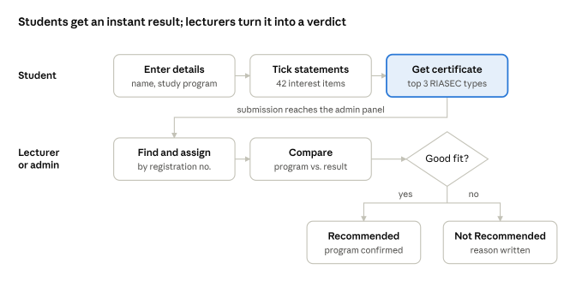
Career Pathway flow · student test and lecturer review
The whole test takes about five minutes. Full-length interest inventories typically take 15 to 40 minutes.
Students say it works
In a validation survey from July to August 2026, 358 students rated the app 4.29 out of 5 on average, and 73.5% gave it a 4 or 5.
Respondents came from more than 160 schools in over 45 cities. What began as a pilot around Bandung and Cimahi spread to Sumatra, Kalimantan, Sulawesi, Bali and Papua, school to school, without paid promotion. Only 0.3% of students rated their experience poorly.
| What students rated | Average score (out of 5) | Students rating 4 or 5 |
| Ease of use | 4.37 | ~82% |
| Relevance of results | 4.23 | ~79% |
| Overall | 4.29 | 73.5% |
The best-rated item was “the steps were easy to follow” (4.43). The team sees the clearest room to grow in how closely results reflect each student’s individual interests (4.17).
From research output to commercial product
The signed handover with SMA Santa Maria 3 Cimahi on 3 August 2026 marked the step from community project to deployed product.
The milestone builds on earlier protection of the work. The software is registered with Indonesia’s Directorate General of Intellectual Property, held by Yayasan Bina Nusantara. The team assesses the app at Technology Readiness Level 9: fully implemented and ready to commercialize.
The partnership currently runs as a free trial, so the app has not yet earned income. That is the next step.
Fast, affordable and built for Indonesian schools
Career Pathway combines three things existing options do not: speed, school-wide reach, and results tied to real Indonesian study programs.
Offline psychology-bureau tests are thorough but take 90 to 120 minutes, need a proctor, and cost Rp 150,000 to 500,000 per student. Generic online tests are quicker but give broad career categories and are sold to individuals. Career Pathway runs in about five minutes on a phone. It is delivered through school guidance teachers, and its planned school license is Rp 50,000 per student.
The market is large. About 3.29 million students finish SMA or SMK each year, and roughly 1.05 million go on to higher education. The team estimates that reaching just 4% of them, around 40,000 students through 130 to 200 partner schools, would generate about Rp 2 billion a year.
The next steps are to sign further partner schools, move from free trials to paid licenses, and sharpen how well results reflect each student’s individual interests.
Try the test at career-pathway.net/test. Schools interested in a partnership can contact the Creativepreneurship Department, BINUS @Bandung.
Comments :