

How Indonesian Universities Build Impactful IP Pipelines to UMKM
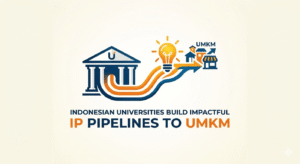
In 2023, lecturers from IPB University deployed what they called a Technosociopreneur training program into rural villages in Nganjuk, East Java — not as a side project, but as a structured part of the Dosen Mengabdi Inovasi (DMI) program, a coordinated mechanism for channelling faculty research outputs directly to UMKM communities in the field. Participants were not passive recipients of a seminar. They were organised into working groups by technology readiness — those already comfortable with digital tools in one cluster, those focused on production in another — and the faculty IP being deployed was documented, tracked, and evidenced. The result was an implementation record that was both auditable and repeatable.
This is the model that is worth studying — not because IPB is exceptional, but because it demonstrates something transferable: the difference between a lecturer visiting a community and a university building a systematic pipeline from IP to UMKM is largely a question of structure, not resources.
Several Indonesian research universities have developed analogous systems. IPB’s incuBie (Pusat Inkubator Bisnis dan Pengembangan Kewirausahaan), which sits under LPPM IPB, applies a participatory mentoring model that involves UMKM actors in every stage of the IP application process — from identifying which technologies are relevant to training delivery to feedback documentation. Research from the incuBie program found that the most effective model for IP-to-UMKM incubation is participatory accompaniment, where the community partner is actively involved in problem diagnosis and solution testing rather than simply receiving a finished product. (LPPM IPB, 2023 — Program Inkubasi UMKM Sektor Pangan, incuBie IPB University)
ITS Surabaya has approached the same problem from the grant side. Through its DRPM (Direktorat Riset dan Pengabdian kepada Masyarakat), ITS has systematically connected faculty IP to external implementation through the Kemdiktisaintek competitive grant system — including the Hilirisasi Riset schemes that now require demonstrated external adoption as a condition of funding renewal. The institutional logic is straightforward: by building implementation pipelines before grants are applied for, the university creates a competitive advantage in grant assessment that reinforces itself over time.
Both approaches share a structural feature that BINUS lecturers can adopt individually, even without waiting for a university-wide programme: the implementation is designed before the IP is registered, not retrofitted after. A lecturer who identifies a community or UMKM partner at the research development stage — and who structures the research output with that partner’s specific needs in mind — arrives at the registration point with an implementation pathway already in place. The evidence collection is planned, not scrambled for after the fact.
For a BINUS lecturer, the practical translation of this model starts with the BRIDGE program and RTT’s partner-matching service. BRIDGE exists specifically to connect faculty research with external organisations who can serve as implementing partners. The conversation does not begin with “I have a certificate, would you use it?” — it begins at the research stage, with “I am developing X for communities like yours. Would you be willing to co-design the implementation?” That framing produces a stronger IP, a more credible evidence package, and a partnership that can sustain multiple Impactful IP claims across consecutive academic years.
The other lesson from peer institutions is the value of documentation infrastructure. The lecturers who generate the strongest Impactful IP records are not those who do the most impressive research — they are those who treat documentation as part of the work, not a post-hoc administrative task. A photograph taken mid-implementation is worth more than ten taken the day before the December cut-off.
BINUS’s Impactful IP framework already provides the structure. What the peer university models add is the habit of building toward that structure from the first day of research, not the last day of the claim window.
For a complete overview of the Impactful IP criteria and how RTT supports the implementation process from research through claim, visit the Impactful IP page at BINUS Technology Transfer.
REFERENCES
https://www.radarbogor.id/2023/11/14/melalui-program-dmi-ipb-2023-pelaku-umkm-merasa-didampingi/
https://id.wikipedia.org/wiki/Institut_Pertanian_Bogor (incuBie program)
https://www.its.ac.id/drpm/kemdiktisaintek-call-for-proposals-melalui-bima/
https://binus.ac.id/techtransfer/impactful-ip/
#ImpactfulIP #UMKM #TechTransfer #IPB #ITSSurabaya #HilirisasiRiset #UniversityIP #BINUS
Comments :