

How BINUS Lecturers Can Use Students to Implement IP and Claim Impact
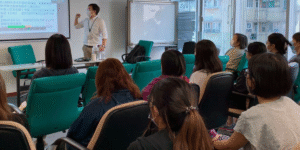
A BINUS lecturer in Information Systems has a validated software tool for small business inventory management — a Copyright registered with DJKI — but no active industry connection. The tool works. The certificate exists. The Impactful IP claim is not happening because there is no external implementing partner. Meanwhile, across the campus, a group of final-year students is looking for a capstone project with real-world application. These two facts are not a coincidence waiting to happen. They are a structural opportunity that most lecturers do not yet connect.
Student programs — particularly PKM-PI (Program Kreativitas Mahasiswa – Penerapan Iptek, or the Students’ Creativity Program in Technology Application), capstone and thesis projects with community components, and KKN (Kuliah Kerja Nyata, community service learning) — are among the most underused IP implementation channels available to Indonesian university lecturers. When structured correctly, they create a deployment pathway that simultaneously advances a student’s academic record, fulfils community service obligations, and generates the external implementation evidence required for an Impactful IP claim.
PKM-PI is the most directly relevant mechanism. Designed by Kemdiktisaintek to channel student innovation toward third-party beneficiaries — including UMKM, community groups, and government bodies — PKM-PI enables student teams to deploy a technology or methodology in a real-world setting with documented outcomes. A lecturer whose IP serves as the technology being applied in a PKM-PI project is not a passive supervisor. They are the originating researcher whose work is reaching the external community that the PKM program is designed to serve. The documentation produced by the students — implementation photos, partner engagement records, progress reports — is precisely the kind of evidence that satisfies an Impactful IP submission. (Kemdiktisaintek / Direktorat Jenderal Pembelajaran, 2018 — Panduan Program Kreativitas Mahasiswa)
The attribution question is important and worth addressing directly. The IP belongs to the lecturer — registered in their name through BINUS and DJKI. The students are the implementation team, not the IP holders. Their involvement does not transfer or dilute the IP claim. What it does is provide a supervised, documented deployment channel that the lecturer could not easily replicate alone, particularly for community-scale implementations requiring on-the-ground presence across multiple weeks or locations.
The ethical dimension is also straightforward when the structure is transparent. Students benefit from working with validated, registered research tools rather than building from scratch; their project has an intellectual foundation and a real-world use case. The community benefits from a technology that has been developed and tested by a research team. The lecturer benefits from an implementation record. This is Tri Dharma — education, research, and community service — working as an integrated system rather than three separate administrative boxes.
For the evidence to satisfy Impactful IP requirements, a few structural conditions must be met. The external implementing organisation must have more than ten members. The implementation must be active — the IP is being used in their operations, not merely demonstrated. The students must produce documentation: photographs showing the IP in use, a formal letter from the partner organisation confirming the nature and scale of the implementation, and a record of the participant count. This documentation package doubles as the material for the lecturer’s HKI Apps claim submission.
A capstone project or final-year thesis with a community implementation component follows the same logic, with slightly different framing. The student’s thesis documents the deployment; the lecturer’s Impactful IP claim documents the impact. Both are strengthened by each other — a thesis with a real external implementation is stronger academically, and an Impactful IP claim supported by a supervised academic deployment is more credible in RTT review.
For a BINUS lecturer ready to use this approach, the first step is identifying which of your registered IP assets has a community or UMKM application, then proposing it as the technology basis for a PKM-PI team or capstone group in the next academic semester. RTT can advise on how to structure the implementation brief so that the student deployment generates evidence that meets the Impactful IP documentation standard from the start.
For a full overview of the Impactful IP process, criteria, and how to submit a claim through HKI Apps, visit the Impactful IP page at BINUS Technology Transfer.
REFERENCES
https://pte.undana.ac.id/program-kreativitas-mahasiswa/ (PKM-PI scheme overview)
https://undiksha.ac.id/en/research-and-innovation/student/pkm/ (PKM goals and IKU connection)
https://old.fikes.unsoed.ac.id/kemahasiswaan/program-kreativitas-mahasiswa-pkm/ (PKM Tri Dharma integration)
https://binus.ac.id/techtransfer/impactful-ip/
#ImpactfulIP #PKM #StudentResearch #BINUS #CommunityService #HKI #TechTransfer #KKN
Comments :