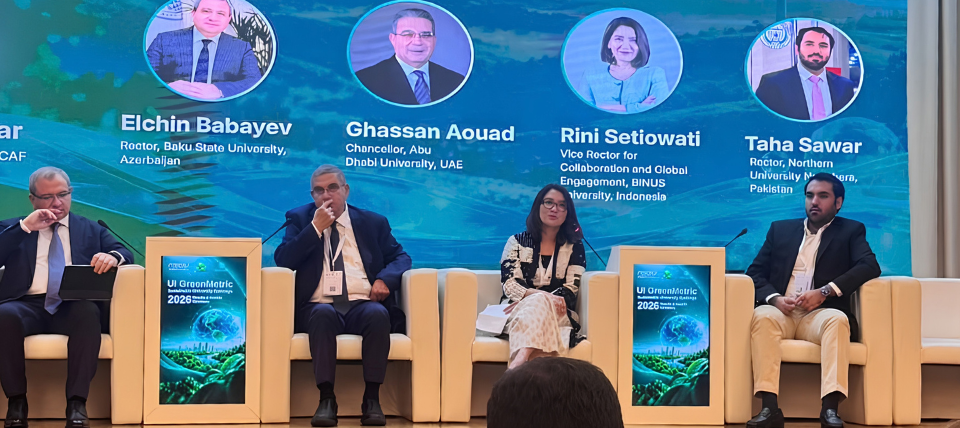
Azerbaijan, 24 September 2026 – Sustainability is a key priority for BINUS University as we continue to integrate green principles into education, research, and campus operations. To share our sustainability efforts and the challenges we have encountered along the way, Vice-Rector Rini Setiowati was invited to join fellow higher education leaders as one of the panelists at the UI GreenMetric Sustainable University Rankings 2026 Results and Award Ceremony, held on 23 September at Azerbaijan State Oil and Industry University.
Under the theme “Greening Higher Education: Strategies, Challenges, and Opportunities for Sustainable Universities,” Vice-Rector Rini Setiowati shared the panel with Rector Elchin Babayev of Baku State University, Chancellor Ghassan Aouad of Abu Dhabi University, and Rector Tawa Sawar of Northern University Nowshera, Pakistan. Drawing on their respective experiences, the panelists shared best practices in advancing sustainability across their institutions and discussed the opportunities and challenges of creating long-term impact through higher education.
One of the topics explored during the discussion was how universities can improve the sustainability performance of existing campus infrastructure, particularly older buildings that were not originally designed with sustainability in mind.
“Retrofitting older buildings remains one of the biggest challenges for BINUS University. With 14 campuses across eight cities in Indonesia, and new campuses being developed every few years, there is often a significant gap between older and newer facilities. The challenge is even greater for campuses located in dense urban areas, where major infrastructure changes can be difficult to implement. As a result, we adopt different approaches for older and newer buildings. For older campuses, we focus on smart campus and smart building solutions by leveraging technology to improve operational efficiency. For newer developments, we have greater flexibility to incorporate sustainability strategies from the planning stage and work closely with campus directors to ensure sustainability is embedded into their development,” explained Vice-Rector Rini.
The conversation then shifted to a thought-provoking question of what would universities prioritize if they were given USD 50 million to support sustainability initiatives? While Rector Elchin Babayev emphasized the importance of investing in projects that deliver long-term value, Vice-Rector Rini offered a broader perspective.
“While green infrastructure is important, our priority would be to build a green society. Creating sustainable impact requires more than transforming buildings and campuses. It means engaging students, faculty members, staff, and the communities around us to become part of the sustainability journey. By fostering awareness, encouraging participation, and building a shared sense of responsibility, we can create bigger impact that extends far beyond the university and benefits future generations,” said Vice-Rector Rini.
Beyond sharing experiences and best practices, the discussion reinforced a common belief among higher education leaders that sustainability is a collective effort that requires the participation of institutions, communities, and society as a whole. Through its ongoing initiatives, BINUS University will continue working toward creating a greener future and broader impact for society.
Author: Mita Adhisti | Editor: Yusuf Rifai
... ... ...