


Collaboration for SDG best practice
BINUS University, through the BINUS Center of Excellence in Sustainability (BIC-SUS), collaborates with RMIT University, Australia, to review international sustainability practices, conduct comparative research, and adapt international frameworks to the Indonesian context. In 2025, this collaboration focused on sustainable procurement, environmental, social, and governance (ESG) practices, sustainability reporting, and Indonesia’s transition towards a low-carbon economy.
The collaboration combines international academic expertise, research, and stakeholder engagement to examine how sustainability frameworks and practices implemented internationally can be adapted to Indonesia’s business environment, regulatory framework, and institutional needs. The key activities include:
- International Knowledge Exchange and Benchmarking
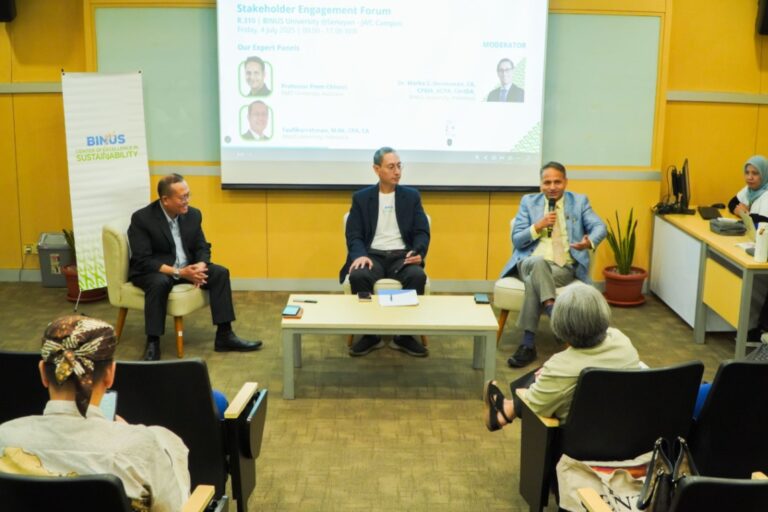
On 4 July 2025, BIC-SUS hosted a Stakeholder Engagement Forum featuring Professor Prem Chhetri from RMIT University. The forum provided a platform for academic and stakeholder discussions on sustainable business practices and the integration of sustainability into institutional strategies. It enabled BINUS to review international approaches and consider their relevance to Indonesian institutions and businesses.
- Adaptation of the Sustainable Procurement Disclosure Index (SPDI)
A central activity of the collaboration is the adaptation of the Sustainable Procurement Disclosure Index (SPDI), a framework developed through RMIT research to assess corporate sustainable procurement disclosures. Originally launched in Australia, the framework provides a basis for evaluating transparency in corporate procurement practices.
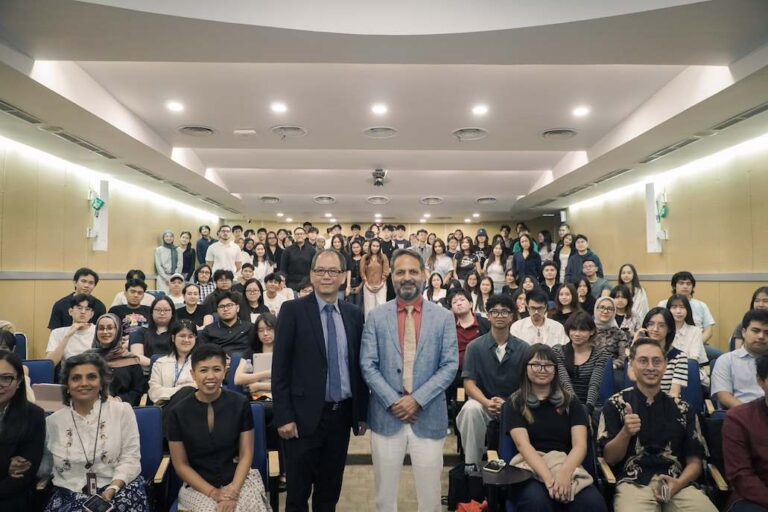
To support the development of SPDI in Indonesia, Professor Prem Chhetri has begun collaborating with two BINUS University academics: Professor Yanthi R. L. Hutagaol, Head of BIC-SUS, with expertise in finance, and Dr. Marko S. Hermawan, a BIC-SUS member and Head of the International Business Management Program, with expertise in accounting. Together, they aim to adapt the SPDI framework to Indonesia’s business practices and regulatory environment.
This work illustrates how an international research framework can be reviewed and contextualised for application in another country, with the aim of strengthening transparency, accountability, and sustainable procurement practices among Indonesian businesses
- Comparative Research on ESG and the Low-Carbon Transition
The collaboration also encompasses research and knowledge exchange on ESG frameworks, sustainability reporting, and Indonesia’s transition towards a low-carbon economy. Discussions have examined energy-transition targets, regulatory challenges, data availability, and institutional readiness, drawing on international perspectives, including Australia’s experience.
By connecting academic research with industry and policy stakeholders, these activities help identify challenges in implementing sustainability practices and inform the development of recommendations suited to Indonesia’s business and regulatory context.
Overall, the BINUS–RMIT collaboration demonstrates how international collaboration, comparative research, and knowledge exchange can support the review and adaptation of sustainability best practices. Through benchmarking, the contextualisation of international frameworks, and research-informed stakeholder engagement, BINUS works with RMIT to explore practical approaches to sustainability that respond to Indonesia’s specific needs.