


Relationships with regional NGOs and government for SDG policy
BINUS University contributes to sustainability-related policy development through direct engagement with government institutions, regional stakeholders, and non-governmental organisations (NGOs). Through academic expertise, research, stakeholder consultations, and community engagement, BINUS supports the identification of societal and institutional challenges, the development of evidence-based strategies, and the formulation of practical recommendations. In 2025, these contributions included national AI policy development, sustainability policy research, strategic capacity building for NGOs, and community-based problem identification.
1. National AI Strategy and Roadmap – Ministry of Communication and Digital Affairs (Komdigi)
In 2025, BINUS University contributed directly to Indonesia’s national AI policy development through its participation in discussions and the national working group responsible for preparing the National AI Roadmap and Ethical AI Guidelines under the Ministry of Communication and Digital Affairs (Komdigi).

On 17 April 2025, Professor Juneman Abraham represented BINUS in a national discussion on Indonesia’s AI strategy and roadmap. The discussion addressed AI research priorities, regulatory needs, governance frameworks, and regulatory sandbox models for emerging technologies.
Subsequently, Ir. Hendy Risdianto Wijaya, S.T., M.T., Ph.D., and Dr. Ir. Indrajani, S.Kom., M.M. represented BINUS in the national working group tasked with developing the White Paper on the National AI Roadmap and the proposed Ethical AI Guidelines.
Through this involvement, BINUS contributed academic perspectives to the formulation of national strategies and governance approaches for the responsible development and use of AI. The process demonstrates direct university participation in identifying emerging technological challenges and informing policy development alongside government, industry, and other stakeholders.
2. BIC-SUS–RMIT Collaboration: Sustainability Policy Research and Recommendations
Through the BINUS Center of Excellence in Sustainability (BIC-SUS), BINUS University collaborated with RMIT University, Australia, on research and policy engagement concerning ESG integration, sustainable procurement, and Indonesia’s transition towards a low-carbon economy.
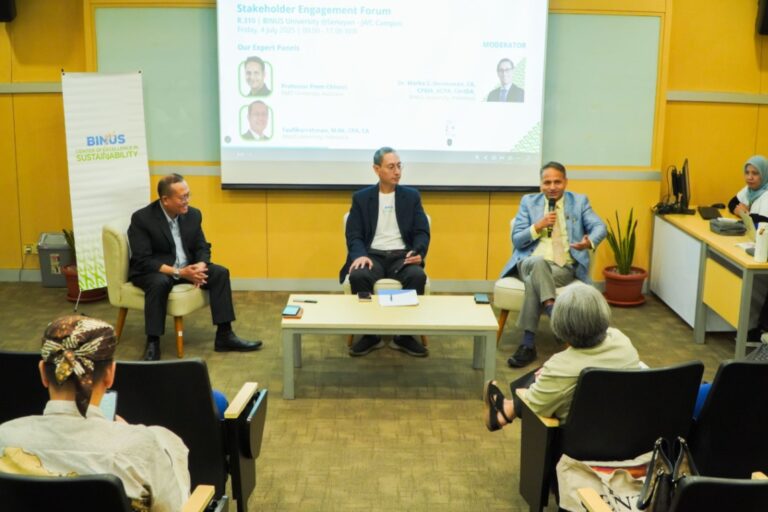
In October 2025, BIC-SUS and RMIT held a multi-stakeholder roundtable involving academics, industry representatives, and policy stakeholders. Discussions examined Indonesia’s energy-transition readiness, the alignment of ESG frameworks with national targets, sustainability disclosures, regulatory gaps, data availability, and institutional readiness.
The collaboration produced a Policy Brief on Energy Transition and ESG Integration, which provides recommendations for policymakers on strengthening ESG governance, improving transparency in corporate disclosures and sustainable procurement, and aligning business practices with Indonesia’s energy-transition priorities. The work also draws on international sustainability frameworks and comparative perspectives to inform recommendations relevant to Indonesia.
This initiative demonstrates how BINUS connects research with policy discussions and stakeholder perspectives to identify implementation challenges and develop evidence-based recommendations for sustainability policy and practice.
3. Strategic Collaboration with SurfAid Indonesia – NGO Capacity Building and Implementation Planning
BINUS University collaborated with SurfAid Indonesia, a non-profit organisation working with remote communities, through the Strategic Business Transformation Workshop: From Vision to Execution, held in Bali on 4 August 2025.
The initiative involved organisational diagnosis, focus-group discussions, capacity-building workshops, prototyping, coaching, and evaluation. BINUS academics worked with SurfAid representatives and local government stakeholders to identify organisational and implementation challenges, particularly the need for sustainable funding and stronger partnerships with public institutions.

The collaboration produced practical planning tools, including a Business Model Canvas, Value Proposition Canvas, strategic plans, project proposals for government contracting, and Key Performance Indicators (KPIs) to measure progress and support implementation.
By strengthening SurfAid’s strategic planning and performance measurement capabilities, BINUS helped the organisation develop a more structured approach to implementing and evaluating its community programmes and exploring partnerships with government institutions.
4. BBS Social Innovation Camp – NGO Collaboration and Community Problem Identification
BINUS Business School, together with Teach For Indonesia and Indorelawan, organised the BBS Social Innovation Camp on 19 July 2025. The initiative involved NGO partners including ISCO Foundation, Kelasekitar, and Komunitas Jendela Jakarta.
Students engaged directly with NGO representatives to understand community needs, identify operational and social challenges, and develop proposed interventions using the Design Thinking approach. The process involved field observations, discussions with NGO partners, and presentations of proposed solutions.

Although the programme primarily focused on community engagement rather than formal government policy formulation, it demonstrates how BINUS supports the identification of social problems and the development of practical, community-informed interventions in collaboration with NGOs.
Overall, BINUS University’s engagement with government institutions and NGOs demonstrates several complementary contributions to sustainability-related policy and strategy development. These include direct participation in national policy working groups, research-based policy recommendations, strategic planning and performance measurement for NGOs, and collaborative identification of community challenges. Together, these activities connect academic expertise with government priorities and practical implementation needs.