

Why DIKTI’s Hilirisasi Agenda Makes SciCom a Policy Priority
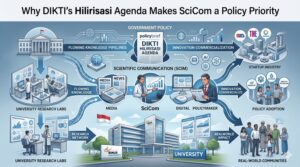
In 2024, Ditjen Diktiristek funded 14,631 research and community empowerment proposals — nearly double the 8,343 funded in 2023. At the contract signing ceremony in Jakarta, Direktur Riset M. Faiz Syuaib delivered a message that went beyond congratulations: quality of research output matters as much as the research itself, and that output is expected to be useful, visible, and accountable to the public that funded it. Indonesia’s hilirisasi agenda — the government’s policy push to ensure that research flows downstream into real industrial applications, community solutions, and societal impact — is changing what credible research looks like from a ministry perspective. Publicly communicated research is increasingly part of that picture.
Hilirisasi, meaning “downstreaming,” is an economic and science policy concept that has migrated from Indonesia’s commodity export strategy into higher education reform. In industrial policy, it refers to ensuring that raw materials like nickel and palm oil are processed domestically rather than exported in raw form. In research policy, the same logic applies: knowledge that stays inside academic journals does not hilirise. It does not flow into industry decisions, government policy, or public behavior. For BINUS lecturers, this has a concrete implication. When DIKTI grant proposals are evaluated — particularly under competitive schemes for applied and collaborative research — reviewers increasingly consider whether the researcher has demonstrated a capacity for public engagement with their findings, not just technical execution.
The BKD (Beban Kerja Dosen) framework and the PO PAK 2019 (Pedoman Operasional Penilaian Angka Kredit) already accommodate this. Popular science articles published in national mass media carry formal angka kredit value under the dissemination component of the Tridharma assessment. Public lectures, media appearances, and documented community engagement activities all contribute to the non-journal dimensions of a lecturer’s academic credit portfolio. What has changed is the policy emphasis: the hilirisasi agenda creates explicit institutional pressure on universities to demonstrate that funded research reaches beyond the campus, and increasingly that pressure surfaces in DIKTI grant renewal cycles and institutional accreditation reviews.
The concept of “luaran penelitian” (research outputs) at DIKTI level has expanded over successive policy cycles to include dissemination indicators that go beyond journal publications. Current DIKTI grant guidelines explicitly include mass media coverage, policy briefs, and community engagement documentation as supplementary evidence of research impact. A researcher who can demonstrate public reach — through #binusresearchpoint posts, a published op-ed in Kompas or The Jakarta Post, or a documented mass media appearance — enters grant review with a richer evidence portfolio than one whose research activity is confined to Scopus-indexed papers alone. The ministry’s message is consistent: research funded with public money should produce public benefit, and evidence of that benefit includes evidence of public visibility.
This is not an argument for superficial content production in place of rigorous scholarship. The strongest case for a BINUS lecturer is the combination: rigorous peer-reviewed publication alongside systematic, documented public communication of what that publication found and why it matters. The two activities reinforce rather than compete with each other. A journal paper without public dissemination reaches only those who already know to search for it. A #binusresearchpoint post without an underlying peer-reviewed paper lacks credibility. The combination — which the BINUS SciCom infrastructure is explicitly designed to support — is what hilirisasi looks like at the level of an individual researcher’s professional practice.
The most direct action a BINUS lecturer can take is to ensure that every externally funded research project — whether under DIKTI, BRIN, or industry partnership — has at least one documented public-facing output: a mass media article, a social media campaign under #binusresearchpoint, or a community-facing output under #binusempowerment. RTT supports this process end-to-end, from content creation to formal submission, and can advise on which SciCom outputs are most strategically relevant for specific grant schemes and Jabatan Fungsional applications.
For the full BINUS framework on science communication channels, reporting, and institutional support, visit binus.ac.id/techtransfer/science-communication.
#Hilirisasi #DIKTI #IndonesianResearch #SciencePolicy #BINUSResearch #ResearchImpact #TridharmaPublicEngagement
Comments :