

Impactful IP Is Not Just for STEM: A Guide for Non-STEM BINUS Lecturers
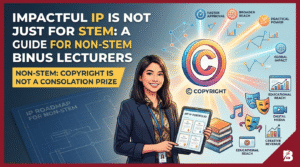
Ask a lecturer from BINUS’s Psychology, Communication, Law, or Design faculty whether they have ever considered registering IP, and the most common response involves a version of: “Isn’t that for engineering?” It is an understandable assumption. The word “patent” dominates the public imagination around intellectual property, and patents are, by design, technical inventions. But patents represent just one of five IP types supported by BINUS and DJKI — and for non-STEM researchers, Copyright is not a consolation prize. It is a faster, broader, and often more practically powerful route to an Impactful IP claim than any other type in the system.
Copyright at BINUS covers software, written works, instructional videos, training modules, artworks, educational curricula, and any other original creative or intellectual expression fixed in a tangible form. This means a psychologist who has developed a validated psychoeducation workbook, a communication lecturer who has produced a documentary for community media literacy, a law faculty member who has written a legal rights handbook distributed through an NGO, or a design lecturer whose visual identity system has been adopted by a social enterprise — all of these produce Copyright-eligible outputs. And all of them, if the output reaches more than ten external users in an active implementation context, qualify for Impactful IP.
The gap between where non-STEM lecturers actually are and where they think they are permitted to go is the core problem. It is not a technical barrier. It is a mental model reinforced by the word “patent” and sustained by the absence of examples that look like their own work.
Consider what an Impactful IP pathway looks like in practice for a BINUS lecturer outside of engineering or computer science. A lecturer in Education Technology develops an instructional design framework and packages it as a replicable community training module. They register it as a Copyright through HKI Apps. An NGO working in rural digital literacy adopts the module for their field teams — fifteen educators across three provinces. The lecturer photographs the training sessions, obtains a formal letter from the NGO identifying the number of participants, the nature of the use, and the organisation’s size, and submits the claim through HKI Apps before the 6 December cut-off. That is a completed Impactful IP claim. No laboratory, no engineering prototype, no patent attorney required.
This is not an exceptional scenario. DJKI’s own data shows that Copyright is the single highest-volume IP type in Indonesia, accounting for the largest portion of the 339,289 IP assets registered in 2024. (DJKI, December 2024 — Refleksi 2024: Strategi dan Inovasi) A substantial portion of those Copyright registrations come from universities, which means the volume of potential Impactful IP claims among non-STEM researchers is considerably larger than the number of claims currently being submitted. The implementation is often already happening — the missing piece is the registration and the documentation.
The cross-disciplinary dimension also matters for grant eligibility. Indonesia’s DIKTISAINTEK BERDAMPAK framework does not restrict its impact-oriented grant schemes to science and technology faculties. Research that addresses social challenges — health communication, legal access, financial literacy, community empowerment, cultural preservation — is actively valued alongside technical innovation. A community-deployed communication module with documented external adoption is as valid a demonstration of research downstreaming as an engineering prototype being tested in a factory. The criterion is impact, not discipline.
For BINUS lecturers in Psychology, Law, Communication, Marketing, Design, Education, or any other non-STEM field, the concrete starting point is an inventory of what already exists. A video lecture recorded for a partner institution is potentially a Copyright. A workshop guide adopted by a professional association is potentially a Copyright. A brand identity created for a social enterprise client is potentially an Industrial Design — and if that client has more than ten members in their organisation, the implementation condition may already be met. The IP has often been produced; it simply has not been registered or claimed.
BINUS RTT offers consultation specifically to help non-STEM lecturers identify which of their existing outputs are registerable, which IP type fits each output, and how to build an evidence package for an Impactful IP claim that passes RTT review. Templates and guidance for Copyright registration are available through the HKI portal at linktr.ee/tentanghkibinus. For a complete overview of what Impactful IP is and how any BINUS faculty member — regardless of discipline — can claim it, visit the Impactful IP page at BINUS Technology Transfer.
#ImpactfulIP #CopyrightHKI #NonSTEM #SocialScience #BINUS #HumanitiesResearch #HKI #TechTransferIndonesia
Comments :