

How to Use Kampus Merdeka and Student Projects to Advance Your PI
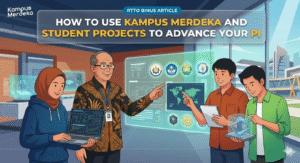
Here is a structural feature of the Indonesian higher education system that most lecturers are using at about half its potential: the Merdeka Belajar – Kampus Merdeka (MBKM) policy allows students to contribute up to 20 SKS per semester to a faculty-led research project and receive full academic credit. The lecturer gains a structured, documented, months-long development contribution. The student gains a meaningful research experience. And if the project is designed intentionally — with the BRIDGE Apps rubric in mind from the outset — the outputs it generates can serve as product development evidence and academic deliverables simultaneously.
The connection is not coincidental. Three of the eight Product Commercialized rubric parameters are precisely the type of output that student research naturally generates. Technology Readiness Level evidence — test protocols, user pilot data, validation summaries — is exactly what students in a research assistantship produce. Technical Documentation — the product architecture, process flow, or framework specification — is a natural output of a well-structured thesis or capstone. Market Readiness evidence — a beneficiary needs analysis, a user survey, a competitive landscape mapping — is standard coursework in business, communication, and management programmes. The only difference between this work counting for a rubric submission and not is whether the lecturer designed the brief to generate submission-ready outputs.
The MBKM Penelitian/Riset pathway formalises this arrangement. Under Kemdiktisaintek’s guidelines, students can serve as research assistants on faculty-led projects for 6–12 months, with the placement managed through the university’s LPPM (Lembaga Penelitian dan Pengabdian kepada Masyarakat) framework. Each student produces documented work logs, milestone reports, and a final deliverable. These documents, if scoped correctly, become the product development timeline that reviewers examine when assessing the TKT parameter. Kampus Berdampak — the programme Ditjen Dikti launched in May 2025 as the successor to MBKM — extends this further by explicitly orienting student research experiences toward applied impact and industry-adjacent problem-solving, the exact context in which product development work sits.
For BINUS specifically, the enrichment programme infrastructure allows students in independent study and research internship tracks to be assigned to product development projects for a full semester. A student briefed to conduct user testing with a defined external beneficiary group, document the results in a structured report, and contribute to a technical specification is performing legitimate academic work and generating rubric-eligible evidence at the same time. The Capstone Project format, increasingly adopted across informatics, engineering, and even business programmes at Indonesian universities, is another vehicle: capstone teams that produce a validated prototype, a competitive analysis, and a user testing report generate outputs that map almost directly to BRIDGE Apps requirements.
The design principle that makes this work is dual-purpose briefing. A lecturer who writes a student project brief that specifies a non-BINUSIAN beneficiary, a testable prototype or framework, a structured testing protocol with measurable outcomes, and a written deliverable formatted as a technical specification — rather than a generic research report — is generating rubric evidence through the normal academic process. This is not gaming the system. It is aligning two legitimate objectives that should have been aligned from the start.
One area requiring careful attention is intellectual property documentation. When students contribute to a product’s development, the HKI registration must clearly document the inventor structure. BINUS RTT advises that student contributions to product development should be acknowledged in the development record but that the HKI filing — particularly for copyright registration — should clarify the rights-holding arrangement before submission. Any ambiguity here directly affects the IP Ownership parameter, which carries 15% of the rubric score.
The broader precedent is clear. ITB DKST’s 2024 Programme Penguatan Inovasi explicitly required participating research teams to span at least two research groups — a structural acknowledgement that multi-contributor teams produce commercially stronger products. Several of ITB’s incubator-track start-ups trace their origins to supervised student capstone projects that a faculty member subsequently developed into a commercial-stage prototype (ITB DKST, 2024 — Program Penguatan Inovasi documentation, dkst.itb.ac.id).
For BINUS lecturers, the practical start is identifying which student-facing academic activity scheduled for the coming semester — a thesis, a capstone project, an MBKM placement — could be designed this year to simultaneously advance your product’s TKT level and generate a documentation output eligible for the December BRIDGE Apps submission. RTT can help map the specific connection during a consultation session.
For the full submission framework and how product development evidence is assessed, visit the Product Commercialization page at BINUS Technology Transfer.
#KampusMerdeka #MBKM #KampusBerdampak #BINUSresearch #capstone #mahasiswaRiset #PIProductCommercialized #hilirisasi
Comments :