


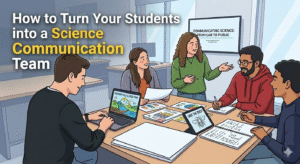
How to Turn Your Students Into a Science Communication Team
A microbiology master’s student at the University of Toronto once spent an evening using petri dishes, bacterial cultures, and a few bottles of colored growth medium to paint a portrait of Frankenstein. She posted it to Instagram under the handle @the_lab_life1. The post received more than 54,000 likes and reached an audience of curious non-scientists, secondary school teachers, science journalists, and prospective students — a combined reach no formal publication of the underlying microbiology achieved. The content was technically accurate, visually compelling, and produced by a student who understood the platform her audience lived on. Her supervisor’s research credibility was attached to every share.
BINUS lecturers supervising undergraduate or postgraduate thesis students are sitting on a content production resource they have almost certainly not activated deliberately. Students — particularly those in communication, design, information technology, business, and creative industries programs — frequently arrive with social media fluency, visual literacy, and an instinctive understanding of what performs well on the platforms that matter for #binusresearchpoint. What they lack is the research substance that only the supervisor can provide. What the supervisor often lacks is the time, the platform instinct, and sometimes the design skill to produce content consistently. The collaboration is not just efficient. It is, when structured intentionally, a training opportunity for a competency that industry consistently identifies as underdeveloped in graduates.
The industry argument for involving students is significant and often overlooked. Gen Z will constitute 30 percent of the global workforce by 2030, according to figures cited at NASW’s ScienceWriters2024 conference. That generation’s ability to communicate complex information to non-specialist audiences — in video, written, and visual formats — is a skill that BINUS’s own industry partner network routinely flags as a gap in new hires. A student who has co-produced science communication content for a research group has a documented, portfolio-worthy demonstration of that skill. A SciCom collaboration is not a deviation from rigorous thesis supervision. It is, if framed correctly, an extension of it.
The practical model is straightforward. A lecturer identifies one recently published or accepted paper and assigns a thesis student or research assistant the task of producing one public-facing output from it. The student proposes the format — a carousel, a Reel, a written post — drafts the copy using the AI-assisted workflow on the BINUS Science Communication page, and prepares a draft for supervisor review. The lecturer checks for accuracy, adds attribution, approves, and the content goes up under #binusresearchpoint with both names visible. Both parties earn the value: the supervisor earns a documented SciCom output toward KPI; the student earns a portfolio piece and practical experience in research translation. Neither outcome requires a significant time investment from the supervisor.
At a slightly more structured level, a research group can formalize this as a recurring expectation: for every paper submitted or published, one SciCom output is produced by a student researcher within 30 days. This creates a consistent production rhythm without placing the content burden entirely on the lecturer, and it gives students recurring practice in a professional skill they will carry into their careers long after the thesis is signed off. The BINUS #binusresearchpoint infrastructure was designed to accommodate exactly this kind of group-based production — posts can be attributed to a research group, not just an individual researcher.
The most direct activation requires a single conversation: tell your current thesis students or research assistants that producing one #binusresearchpoint post per semester — based on research they are already working on — is a valued and supported part of the research collaboration. RTT holds quarterly training sessions open to both lecturers and students, and the content creation workflow is supported end-to-end by the Downstreaming team for groups who want guided onboarding.
For tools, prompts, and the full content creation workflow that makes student-led science communication achievable, visit the BINUS Science Communication page at binus.ac.id/techtransfer/science-communication.
#StudentResearch #ScienceComm #BINUSStudents #ResearchMentoring #binusresearchpoint #ThesisSupervision #AcademicTeaching
Comments :