

How NUS, ITB, and UI Do Research Commercialization — Lessons for BINUS
When the National University of Singapore rebranded its Industry Liaison Office, the new name carried a deliberate signal: Technology Transfer and Innovation — TTI, not ILO. The addition of “innovation” was not cosmetic. NUS TTI now explicitly frames its mandate around start-up creation and entrepreneurship alongside IP licensing — a structural acknowledgement that the most competitive research universities in the region are treating commercialization not as an IP admin function, but as an ecosystem development priority. For BINUS lecturers, the comparison with regional and national peers is not an exercise in institutional pride. Understanding where the bar is set — and how different institutions activate their commercialization infrastructure — helps you position your own product more strategically within a landscape you will increasingly be competing in.
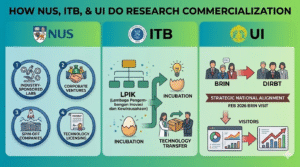
The NUS model is built around four primary mechanisms: Technology Development Agreements for co-developing research toward higher TRLs with industry partners, Commercial and Evaluation Licenses for market-ready IP, gap funding from Singapore’s Ministry of Education for mid-TRL research, and a start-up creation pathway through NUS Enterprise and the BLOCK71 global incubation network. The model is sophisticated and resource-intensive. It is also, notably, not accessible to early-stage outputs: the NUS TTI system typically activates for products at TRL 6 and above, where demonstrated industry interest can be documented. A researcher with a TRL 4 proof of concept would not trigger the commercialization machinery at NUS. At BINUS, the same product is eligible for a Product Commercialized PI submission, with 72.5% of the rubric score attainable at that stage.
ITB’s journey is instructive from a different angle. The Lembaga Pengembangan Inovasi dan Kewirausahaan (LPIK) — which managed ITB’s innovation portfolio for over a decade — was restructured into the broader Direktorat Kawasan Sains dan Teknologi (DKST) in 2024, consolidating IP management, business incubation, and Science Techno Park operations under one directorate. At the ITB CEO Summit held in August 2024, innovation leaders from UGM, ITS, and ITB gathered specifically to grapple with the challenge of product valuation — how to assess the market-readiness of innovations before a commercial buyer exists. ITS Vice Rector Agus Muhamad Hatta noted at the summit that “collaboration with experts who understand the market is very necessary to ensure success in innovation downstreaming.” This is precisely the function BINUS RTT’s three-reviewer panel performs in the annual Product Commercialized assessment — a structured, multi-lens market-validity check embedded directly into the PI process, before any external commercialization is attempted (ITB/DKST, 2024 — ITB CEO Summit: Seminar Kolaborasi dan Inovasi, itb.ac.id).
UI’s innovation infrastructure took a significant institutional step in February 2026, when BRIN (Badan Riset dan Inovasi Nasional — National Research and Innovation Agency) visited UI’s Direktorat Inovasi dan Riset Berdampak Tinggi (DIRBT) to discuss collaboration on the Rumah Inovasi Indonesia programme — a national initiative to build regional innovation hubs anchored to universities. BRIN’s Directorate of Regional Research and Innovation Policy explicitly cited UI’s capacity to “manage intellectual property and downstream research ready for regional implementation” as the basis for the partnership. The language matters: what BRIN is looking for in a university partner is documented TKT evidence, registered IP, and a product portfolio ready for handover to regional implementation contexts. These are exactly the outputs the BINUS Product Commercialized process generates annually (BRIN/UI DIRBT, February 2026 — Kolaborasi Rumah Inovasi Indonesia, innovation.ui.ac.id).
The pattern across all three institutions is consistent: formal commercialization infrastructure activates most powerfully for products that are already documented, IP-registered, and TRL-assessed. What distinguishes BINUS’s approach is that the PI framework incentivises this documentation from TRL 4 onward — earlier than most peer institution systems activate — meaning that BINUS lecturers who engage seriously with the submission process are building a product profile that qualifies for the same external opportunities their NUS, ITB, and UI counterparts pursue.
For BINUS lecturers, the strategic opportunity is clear: the annual BRIDGE Apps submission is not just an internal performance metric. It is the process through which a product acquires the documented credentials — registered IP, assessed TKT, validated market analysis — that external ecosystem actors across the region are looking for when they select research partners.
For a full overview of how BINUS RTT supports your product from early TRL through to market positioning, visit the Product Commercialization page at BINUS Technology Transfer.
#NUS #ITBDKST #UIDIRBT #BINUSresearch #techTransfer #komersialisasiRiset #benchmarkPT #hilirisasi
Comments :