

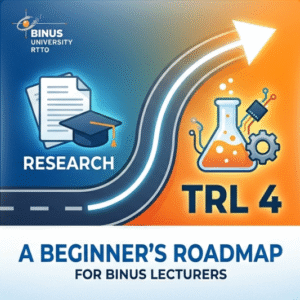
From Research Paper to TRL 4: A Beginner’s Roadmap for BINUS Lecturers
Here is a scenario that plays out more often than it should. A lecturer in Communication Studies publishes a well-received paper on misinformation detection frameworks for local news consumers. The paper gets cited, receives a B+ equivalent in the SINTA scoring system, and sits in the digital library. Three years later, the same lecturer is completing their BKD (Beban Kerja Dosen — Academic Workload Report) and realising, too late to act, that they have no product-related PI claims. The research was real. The applied potential was obvious. The submission never happened.
This article is for that lecturer — and for any BINUS researcher who has published work with clear practical application but has never turned it into a product submission. The five-step roadmap below is not a shortcut. It is a sequence, and it works for non-STEM disciplines as readily as for engineering and computer science.
The first step is applied problem identification. Every piece of research addresses something — a gap, a dysfunction, a need. The task at this stage is not to redesign your research but to re-articulate it in product language. Who, specifically, would benefit from a tool, method, framework, or system built on your findings? That beneficiary cannot be a BINUSIAN — the PI rubric requires the intended user to be external to the university. A misinformation detection checklist designed for community journalists in Tier-2 Indonesian cities is a product. A training module for SME managers based on your organisational behaviour research is a product. The beneficiary definition is what transforms a research output into a product concept.
The second step is minimal concept formalisation. At TKT 4, you are not required to have a finished prototype. You need what the framework describes as “a proof of concept validated in a laboratory environment” — in practical terms, this means your proposed solution has been tested against real data or with real users in a controlled setting, even informally. A pilot survey, a user-tested prototype, or a validated framework applied to a real dataset all qualify. Document this test in writing. This becomes your TKT evidence and directly feeds the Technology Readiness Level parameter, which carries 15% of the rubric score.
The third step is HKI registration. HKI — Hak Kekayaan Intelektual (Intellectual Property Rights) — is the most misunderstood part of this process. Many lecturers assume they need a patent, which is expensive, slow, and technically demanding. In reality, a copyright (hak cipta) — which can be registered for a module, a framework document, a software application, or a creative work — is sufficient to satisfy the IP parameter in the rubric. BINUS RTT, through the HKI Apps platform, supports the copyright registration process. The cost is minimal and the timeline is significantly shorter than a patent application. This step alone unlocks 15% of your rubric score.
The fourth step is market context documentation. This does not require a formal market research study. It requires a clear, specific written statement covering three things: who your product is for, what problem it solves that existing solutions do not, and what the scale of that need looks like. One to two pages, grounded in your existing research references, is sufficient. This document directly feeds the Market Readiness (12.5%) and Competitive Advantage (15%) parameters — together, 27.5% of your total score — and is often the single easiest place to gain points in a first submission.
The fifth step is the BRIDGE Apps submission itself. Register your product profile on the platform, upload your evidence across the eight rubric parameters, and submit before December 6. Three reviewers — from RTT, from industry, and from within BINUS — will assess your submission and may schedule a clarification interview. Go in prepared to explain your beneficiary, your TKT level, and your IP status. The interview is a strength, not a risk: it gives you a chance to contextualise evidence that the document alone might not convey.
For context on eligibility scope: Kemdiktisaintek’s 2025 Hilirisasi Riset programme explicitly includes social humanities, education, arts, and culture as eligible research areas — confirming that the national framework recognises non-technical products as valid applied outputs. BINUS’s rubric is consistent with this.
The consultation that makes this entire process faster is the Product Strategic Roadmap session available through BINUS RTT. Book it at the start of the process, not after you have hit an obstacle.
For the full submission process and rubric guide, visit the Product Commercialization page at BINUS Technology Transfer.
#BINUSresearch #TRL4 #TKT #hilirisasi #BRIDGEApps #HKI #PIProductCommercialized #dosenBINUS
Comments :