


Gamelan Diplomacy: Connecting Culture and Humanity
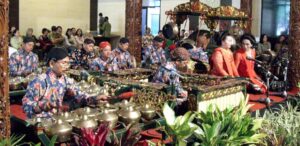
When the bronze instruments of a gamelan ensemble begin to resonate, there’s something almost magical in the air. Each gong, saron, and bonang strikes not just a note but also builds a sense of unity, with every sound forming a coordinated rhythm that depends entirely on harmony and cooperation. For Dr. Yosef Dedy Pradipto, L.Th., M.Hum., M.Si., this harmony holds lessons far beyond music. It’s a reflection of how people, cultures, and even nations can coexist and thrive together.
As a lecturer and researcher at BINUS University, Dr. Yosef has long been fascinated by the deeper meaning of gamelan. Growing up in Surakarta, the heartland of Javanese tradition, he witnessed how music was more than entertainment, it was a language of community. This personal connection inspired his international research project titled “Cultural Internationalization Strategy with Social Capital Approach: Case Study of Gamelan as a Cultural Heritage under UNESCO.”
The study began after a proud national moment: in 2021, UNESCO officially recognized gamelan as an Intangible Cultural Heritage of Humanity. But Dr. Yosef noticed something intriguing. The push that led to this recognition didn’t come from government policy or big institutions, it came from teachers, local artists, and cultural enthusiasts. “It wasn’t the government that made gamelan global,” he explains. “It was the people, the activists, the educators, the communities. They were the real diplomats.”
This realization became the foundation of his research: that cultural diplomacy doesn’t always happen through embassies or ministries. Sometimes, it begins in classrooms, community halls, and humble music studios. At the center of this dynamic lies what sociologists call social capital: the trust, relationships, and cooperation that enable collective action that create real, lasting impact.
To understand this phenomenon, Dr. Yosef’s team, in collaboration with University of Richmond’s ethnomusicologist Dr. Andy McGraw, conducted field studies and focus group discussions (FGDs) across several countries, including the United States, the United Kingdom, and Japan. What they discovered was unexpected, and profoundly human.
In these countries, gamelan had found new life not as an exotic performance, but as a form of therapy and social connection. “We were surprised,” Dr. Yosef recalls. “In the U.S., gamelan groups often include people struggling with loneliness. In Japan, it’s used as therapy for children with developmental challenges. And in the UK, it’s even helping young inmates rediscover confidence and identity.”
What unites all these experiences is the healing power of togetherness. Unlike Western orchestras that emphasize individual virtuosity, gamelan demands cooperation—no one instrument can dominate. Every player must listen to one another, synchronize, and adapt. “It’s a living metaphor for empathy,” Dr. Yosef says. “Through gamelan, people learn to listen again, not just with their ears, but with their hearts.”
This insight reshaped the direction of his research. Initially, the team planned to develop a digital training app to help teach gamelan online. But after the FGDs, participants, especially from Western countries, strongly opposed digitizing it. They argued that gamelan’s true value lies in its physicality: the shared presence, the sound vibrations, and the human touch.
“They told us that the beauty of gamelan is precisely in its tradition, its authenticity,” Dr. Yosef says. “In an age of screens and isolation, gamelan becomes a rare space where people truly connect. That was an unexpected, yet powerful finding.”
From these findings, Dr. Yosef and his team began developing a new model of cultural internationalization, one that doesn’t treat culture as a product to export, but as a relationship to nurture. This model suggests that Indonesia can use its cultural heritage, like gamelan, as a form of soft power, a way to engage with the world through empathy, not authority.
He plans to turn this research into policy recommendations for the Indonesian Ministry of Foreign Affairs and the Ministry of Culture, urging them to incorporate people-centered diplomacy in cultural programs. Instead of just sending performers abroad, Indonesia could create collaborative workshops, healing communities, and educational exchanges based on gamelan’s philosophy of harmony.
But perhaps the most inspiring part of Dr. Yosef’s research is how it reframes Indonesia’s role in the world. “For too long, we’ve seen culture as something to showcase,” he reflects. “But culture can also be a way to heal. It can bring meaning, identity, and hope, not only for us but for others who need it.”
Looking ahead, Dr. Yosef hopes this model can extend beyond gamelan to other forms of Indonesian heritage, from batik and wayang to local rituals and traditional wisdom. Each, he believes, holds untapped potential to foster compassion and social connection globally.
In a time when the world faces rising isolation, digital overload, and disconnection, Dr. Yosef’s research reminds us that the answers may not lie in new technologies or policies, but in something far older, and more human.
Because sometimes, diplomacy doesn’t start with words. It starts with rhythm.
With listening.
With harmony.
And perhaps, in the gentle sound of a gong fading into silence, we find not just music, but a map back to one another.
Comments :