

When Research Looks for a Partner: Inside BINUS’s Technology Transfer Festival
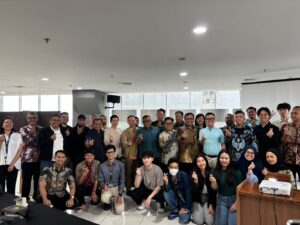
When Research Looked for a Partner: Inside BINUS’s Technology Transfer Innovation Festival 2025
The BINUS Technology Transfer Innovation Festival 2025 opened with a shared voice. University leaders took the stage alongside a representative from the Directorate of Diktisaintek at Indonesia’s Ministry of Education, Culture, Research, and Technology. Together, they delivered one clear message: research cannot remain an internal achievement. Its value must be tested, shaped, and carried into the wider world.
This joint opening was more than protocol. It framed the day as a collaborative effort between policy, academia, and industry. Innovation is not the responsibility of a single actor. It is a system that only works when its parts move together.
From that moment on, the festival followed a deliberate sequence designed to move research from “ready on paper” to “ready for adoption”, through two main tracks: Business Proposal Demo Day and Industrial-Solution Matching (ISM).
Two tracks, one mission: turning research into real-world adoption
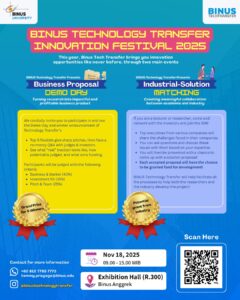
BINUS Tech Transfer designed the festival as a practical bridge between research readiness and industry relevance.
1) Business Proposal Demo Day
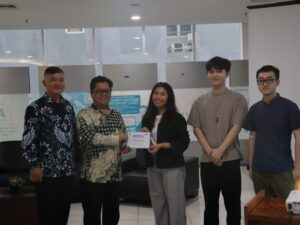
The first track focused on how research becomes a scalable business proposition. Instead of presenting projects as academic milestones, Demo Day treated them as early products in need of validation, traction, and partnership pathways.
A standout highlight was the pitch session where Top 5 finalists delivered sharp presentations and faced a rigorous Q&A with judges and investors. The structure made a simple truth visible: a strong idea is not enough. Research must also survive real-world scrutiny.
To keep the assessment grounded, the event applied clear judging criteria:
- Business and Market (40%)
- Investment Fit (35%)
- Pitch and Team (25%)
2) Industrial-Solution Matching
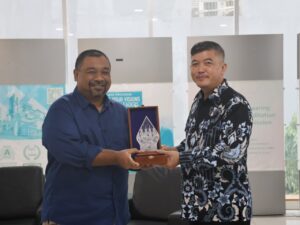
If Demo Day tested research as a business, ISM tested research as a solution.
This segment brought lecturers and researchers into direct discussion with executives who brought real operational problems to the room. The format was intentionally collaborative: company representatives shared challenges, researchers engaged with questions and perspectives, and participants were guided toward forming solution proposals.
What made ISM especially meaningful was its diversity of problem statements. Industry partners came from multiple sectors and offered concrete themes for collaboration, including:
- PT. Masadepan Indonesia Digital: Smart Traffic Light
- Koperasi Produsen Kristal Laut Nusantara: Ekosistem Garam
- PT. Sari Teknologi Global: Smart Warehouse Management System
- PT. Digital Mediatama Maxima Tbk.: Smart Ritel
- Fa. Bhakti Nusantara Konsultama: Alat bantu berbasis AI untuk konsultasi pajak
- PT. Mitra Integrasi Informatika: Mensortir CV dengan AI
- PT. Trimitra Sistem Solusindo: Labor Profiling and Matching System
- PT. Spora Tehnika Indonesia: Talent Pool Tenaga Terampil Ekosistem EV
Rather than being theoretical, these themes gave researchers a clear “entry point” to contribute: optimize systems, strengthen decision-making, improve operational efficiency, and build applied solutions that can be piloted and measured.
Why research often stops too early
After the opening remarks, BINUS representatives outlined the bottleneck the festival set out to address. Across universities, research increasingly reaches prototype stage. Concepts are proven. Early models are built. Yet many of these projects never progress further.
The obstacle is rarely scientific. More often, it lies in what comes next.
Researchers may lack access to industry networks. Companies may struggle to assess academic work without context. Legal protection, feasibility analysis, and market understanding often arrive too late. The result is research that stalls, not because it fails, but because it is never properly introduced.
The festival positioned itself as a response to that gap: not evaluating ideas in isolation, but creating structured encounters between research and potential adopters.
The role of the technology transfer unit: curating and translating
Before any pitch or matching began, a key step happened behind the scenes: BINUS’s technology transfer unit curated and filtered research prototypes deemed ready to be introduced to industry.
This mattered. The festival was not designed as an open bazaar of ideas. It was a focused meeting where industry participants were invited into guided conversations with research that had already been assessed internally for relevance and development potential.
By centering this process, BINUS signaled that technology transfer is not an afterthought. It is an active, professional function within the university, responsible for bridging the language and expectations of academia and industry.
From presentation to partnership: where the “matching” became real
As the day progressed, the atmosphere shifted from structured presentation into real dialogue.
ISM conversations revealed the most human and practical dimension of collaboration. Researchers spoke openly about uncertainty and development needs. Industry representatives raised practical concerns about scale, integration, regulation, and operational constraints. Both sides acknowledged that interest alone does not guarantee success.
That honesty is exactly what makes matchmaking productive. Some conversations ended quickly. Others deepened into concrete next steps, follow-up meetings, and early alignment. By the end of the festival, it was clear this was not merely an event flow. It was a working mechanism.
Importantly, this was a past event, and it landed as a success. The outcome was not measured by ceremonial announcements, but by the volume and quality of new ISM connections made, and the momentum that followed.
Institutional alignment behind the scenes
Interwoven throughout the festival were explanations of how BINUS supports this process internally. University leaders described how research development, intellectual property management, industry engagement, and commercialization pathways connect as a system.
For researchers, it clarified where support exists beyond prototype stage. For industry, it reassured them that engagement with BINUS is structured and supported, not dependent on individual relationships alone.
The message across sessions stayed consistent: innovation requires alignment, not improvisation.
The committee behind the execution
Events like this require more than a strong concept. They require operational discipline and coordination across stakeholders.
The Technology Transfer Innovation Festival 2025 was led by a committee that ensured the program ran end-to-end, from curation to stakeholder coordination and on-ground execution:
- Hendy Risdianto Wijaya (Head of Committee)
- Tommy Prayoga
- Syarli Noorsyablina,
- Hida Farida,
- Yohannes Albert Kembarenta
- Ahmad Arif Nurahman
Their work shaped the festival into something functional: not just a stage for presenting research, but an environment where real conversations could start and progress.
Why this matters now
The festival reflects broader shifts in Indonesia’s research landscape. Public funding increasingly emphasizes impact. Universities are expected to contribute directly to economic development and societal needs.
At the same time, industry faces pressure to innovate efficiently and responsibly. Collaborating with universities offers access to new ideas, but only if those ideas are accessible and supported.
By structuring the festival around curated introductions, pitch scrutiny, and industry-driven solution matching, BINUS positioned itself as a bridge between these expectations.
For society, the implications are tangible. When research finds the right partner, solutions move faster into use: smarter systems are deployed, educational tools reach classrooms, operational problems are solved locally, and research outcomes translate into economic and social value.
Ending with momentum, not closure
The festival did not end with a “closing chapter”. It ended with momentum.
Some conversations moved into follow-ups. Some evolved into early solution proposals. Many new ISM connections were made, validating the core idea behind the festival: innovation accelerates when research is placed in the same room as real challenges, real decision-makers, and a structured pathway for collaboration.
BINUS Technology Transfer Innovation Festival 2025 showed a grounded approach to innovation. Not as a spectacle, but as a guided encounter. In that encounter, research stopped waiting. It started finding partners capable of carrying it into the world.
Comments :