


From Knowledge to Change: Building the BINUS Research and Technology Transfer Booklet
It started with a familiar problem: too many good stories, scattered everywhere.
Across BINUS, breakthroughs were happening in labs, in classrooms, in villages, in international competitions, and inside long-running partnerships. Some lived as journal papers. Some lived as prototypes. Some lived as community programs that quietly changed local economies. But if you were an industry partner, a policymaker, or even a student trying to understand what BINUS research actually does, you would have to dig through multiple websites, reports, and event recaps to connect the dots.
So we decided to do the opposite of “add more information.”
We decided to build one clear narrative. One ecosystem map. One booklet that could sit on a meeting table and answer a stakeholder’s unspoken questions in minutes: What is BINUS good at? How do we collaborate? Where do I start? What proof do you have? And what can this become in the real world?
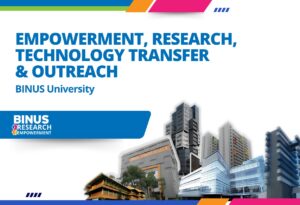
That was the beginning of From Knowledge to Change: The BINUS Research & Technology Transfer Ecosystem, Where Innovations Foster and Empower Society.
The first page is not about data, it is about belief
When you open the booklet, the story does not begin with KPIs. It begins with identity.
BINUS started in 1974. From a small institution in Jakarta, it grew into a university with nine campuses across Indonesia. That growth matters, but not because it is impressive on paper. It matters because each campus carries the same purpose: nurturing talent, empowering communities, and building solutions that respond to real-world challenges.
The booklet is designed to communicate one foundational belief: education, combined with technology, has the power to transform lives and strengthen societies. This belief is what makes the rest of the booklet feel connected, not like a list of unrelated achievements.
Then we introduce the “engine room”: Research and Technology Transfer at BINUS
Every strong story needs a center of gravity. In this booklet, that center is the Research and Technology Transfer (RTT) unit at BINUS University.
RTT is portrayed as more than an administrative office. It is the system that makes research move forward and move outward. It supports the full research journey: internal and external grants, Scopus-indexed publication support, conferences, book publishing, research capacity building through roadmaps, workshops, and seminars.
But the most important thing we wanted readers to feel is this: RTT is where research becomes something usable. RTT is also responsible for intellectual property, research ethics, commercialization, university-industry collaboration, spin-offs, and research communication that translates complex work into public value. On the societal side, RTT also champions community empowerment programs across Indonesia, with impact measurement and long-term program design.
In a single chapter, a stakeholder can understand: BINUS is not just producing knowledge. BINUS is designed to translate knowledge into outcomes.
We map the people, because ecosystems are built by humans
A booklet like this can easily become overly institutional. So we make sure it stays human.
We spotlight key researchers and academic leaders, not as “names to impress,” but as anchors of expertise and collaboration potential. Figures like Prof. Bens Pardamean and Prof. Dr. Meyliana become proof points: BINUS has scholars with global relevance in AI, digital systems, and emerging business technologies.
Then we show the pipeline behind them. Students are not presented as passive learners, but as early contributors through programs like the Enrichment Program Research Track and competitive pathways such as Mawapres. Graduate students are positioned as the next layer of leadership, supported by scholarships, mentoring, and structured development in research methods, publishing strategy, and IP management.
This matters because many partners do not only want a project. They want continuity. They want talent. They want assurance that collaboration will not collapse when one team rotates. The booklet makes it clear: BINUS builds the next generation into the system.
We add numbers, but only after the reader has context
Once the reader understands the mission and the people, we bring in measurable indicators: research outputs, Scopus-indexed publications, citations, SINTA scores, and rising IP registrations.
We are careful in the storytelling here. The numbers are not treated as trophies. They are treated as signals of maturity. They say: BINUS has consistency. BINUS has scale. BINUS produces research that is read, cited, and built upon.
This is the moment the booklet shifts from “interesting” to “credible.”
Then we deliver what stakeholders truly come for: proof of real-world impact
This is where the story becomes concrete.
The booklet highlights applied cases that show research leaving the academic world and entering public and market realities. A strong example is BINUS’ contribution to mineral downstreaming policy through AI and big data analysis, including a platform like petahilirisasi.id that provides real-time insights and strengthens national strategy. Other examples show industry and community innovation: health and biotech research with precision applications, and agricultural empowerment innovations like Smart Dome 4.0 that support post-harvest independence.
In this section, the reader stops asking, “What is your research?” and starts asking, “How can we work together?”
We show the ecosystem as infrastructure, not just ideas
To make the system feel real, the booklet does not rely on abstract claims. It shows the backbone: research centers and research interest groups, specialized labs across campuses, and practical spaces that bridge education with execution, such as incubator environments and simulation labs.
Then we explain how breakthroughs are fueled: internal funding schemes and external grants from national and international bodies. We also highlight the operational layer: a grant facilitation unit, internal proposal systems, and collaboration platforms that keep projects trackable and scalable.
To a partner, this answers a crucial concern: “Do you have the capacity to deliver?” The booklet says yes, and it shows how.
We make trust a chapter, not a footnote
In partnerships, trust is often the real barrier.
That is why governance and openness are not placed at the end. Research ethics, academic integrity tools, IP support, and tech transfer alignment with national law are presented as part of the ecosystem’s design. The booklet also reflects BINUS’ commitment to Open Science through FAIR principles, open data practices, and an accessible repository.
This is the section that reassures a policymaker and convinces a corporate partner: collaboration here is professional, structured, and accountable.
The shift from ecosystem to portfolio: research becomes products
After establishing the system, Section II becomes the “showroom.”
Here the booklet shifts tone. Instead of “what BINUS is,” it becomes “what BINUS has.” Research products are clustered into themes to help stakeholders quickly navigate: Health and Biotech, Digital Platforms for Empowerment, AI and Immersive Tech for Education and Culture, Smart Systems and IoT.
Each product is presented like an offer, not like an academic abstract: what it is, what makes it different, why it matters, next steps, and commercial pathways. The assessment matrix becomes a practical tool for decision-makers to prioritize collaboration, certification, piloting, licensing, or scaling.
The point is simple: this booklet is not just for reading. It is for action.
The catalogue closes the loop: from TRL 1 to mass impact
Section III, the Strategic Innovation Catalogue 2023–2025, is where the narrative becomes complete.
It lays out the pipeline: early-stage research (TRL 1–3), validated technology transfer projects (TRL 4–9), and community engagement initiatives that create measurable, SDG-aligned impact. The reader can see the pathway from student competitions and conceptual projects, to prototypes like DAELY, to long-term village empowerment programs in Labuan Bajo, Gunung Puntang, and Wonokitri.
At this point, BINUS is no longer a university “with research.” BINUS is an innovation ecosystem with a pipeline.
And behind the booklet, a team making the system visible
This story would not work without the people shaping it into clarity.
The booklet is made possible by a committee that connects writing, downstreaming logic, outreach, community impact, and roadmap governance: Haryo Sutanto (Section Head of BINUS Journal), Tommy Prayoga (Section Head of Downstreaming), I Gusti Bagus Agung Oka (Community Empowerment), Alicia Diana Teresa (Outreach), Iga Dinaris (Research Roadmap), and Tsabita Dinilah (Research Roadmap).
They are the reason the ecosystem can be read like a story, not like a database.
What the booklet is really for
In the end, this booklet is not just a publication. It is a bridge.
It is made to accelerate collaboration and shorten the distance between a question and an outcome:
- For industry: a clearer entry point to co-develop, pilot, license, or adopt BINUS innovations.
- For government: a map of research capacity that can inform programs, policies, and applied solutions.
- For associations and communities: proof that partnerships can create long-term empowerment, not one-off events.
- For students and researchers: a visible pathway showing that research can lead to products, enterprises, policy contributions, and societal change.
And that is why we called it From Knowledge to Change.
Because at BINUS, research is not meant to stay inside campus walls. It is meant to travel, to meet the world, and to return as impact.
Comments :