


Bridging Labs and Markets: BINUS Delegates at KSTI Indonesia 2025
Bridging Labs and Markets: BINUS Delegates at KSTI Indonesia 2025

Sasana Budaya Ganesa (Sabuga) in Bandung has hosted countless academic moments, but on 7–9 August 2025, it felt like a national “switchboard” for ideas. Researchers, industry leaders, and policymakers moved between plenary halls, exhibition booths, and business matching tables with one shared question: how do we turn Indonesia’s research capacity into real economic growth that is felt more evenly across society? That is exactly the premise of the Convention of Science, Technology, and Industry Indonesia (KSTI) 2025, organized by the Ministry of Higher Education, Science, and Technology (Kemdiktisaintek) in collaboration with ITB, under the theme “Science and Technology for Economic Growth & Equity.” (KSTI2025)
For BINUS, KSTI was not just another conference to attend. It was a live marketplace of problems, prototypes, and partnership signals, a rare space where technology transfer conversations can start in minutes, not months. Representing BINUS as delegates from the technology transfer team were Hendy Risdianto Wijaya, Elioenai Sitepu, and Tommy Prayoga, joining thousands of participants from across the ecosystem.
Why KSTI mattered in 2025
KSTI 2025 was built around a national urgency. President Prabowo Subianto has publicly emphasized an 8% economic growth target and framed the path forward as a shift from an extractive economy to a high value-added industrial economy, supported by stronger science, research, and technology capability. (KSTI2025)
That framing showed up in the event design itself. Beyond the headline plenaries, KSTI structured its content around Asta Cita’s priority research fields, spanning food security, energy, defense, digitalisation (including AI and semiconductors), health, downstreaming and industrialisation, maritime, and advanced materials and manufacturing, plus frontier science. This was not an abstract theme list. It functioned like a national “collaboration menu,” telling universities and companies where the country is placing its bets. (KSTI2025)
The scale also made it different. Government communications around the event described participation in the thousands, with large representation from researchers and university leadership, and the program explicitly connected research outputs to industry needs through exhibitions and business matching. (Setkab)
Walking into a three-day pipeline builder
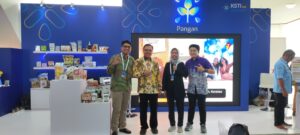
From the moment the sessions began, KSTI felt engineered to collapse distances between “research talk” and “industry action.” The official schedule combined exhibitions across the priority sectors, parallel discussions, plenary sessions featuring world-class scientists (including Nobel Laureates), and dedicated business matching sessions. (KSTI2025)
For a technology transfer delegation, this kind of agenda changes the job on-site. You are not only there to listen. You are there to translate: to take what you hear in policy direction, what you see in prototype showcases, and what you learn from industry pain points, then connect them back to potential research collaboration and downstream pathways.
That is where BINUS’ delegation focused their attention.
The highlight: meeting inventors, industries, and future collaborators
Across the event’s exhibition areas and matching sessions, the BINUS delegates met with inventors and innovators who were already thinking beyond publications. Some conversations began with a simple “what does this prototype need next?” and quickly turned into the language of collaboration: pilot opportunities, validation partners, applied research support, and potential co-development routes.
Equally important were meetings with industry stakeholders who came with sharper questions:
- Can this solution scale?
- Who owns the IP if we co-develop?
- What evidence is needed before procurement or adoption?
- How fast can a campus partner deliver iteration cycles?
These are the exact questions technology transfer teams need to hear early, because they reveal the real gap between promising research and adoptable solutions. And at KSTI, those gaps surfaced naturally, because the room included both the builders and the buyers.
KSTI’s emphasis on connecting research and economic contribution was repeatedly highlighted in official narratives around the event, including the push for research outcomes to go beyond “knowledge” and toward economic and industrial relevance. (Antara News)
What BINUS gained, strategically
KSTI worked like a high-speed sensing mechanism for BINUS technology transfer priorities:
- A clearer map of demand
The Asta Cita sector framing helped translate broad national priorities into concrete partnership categories, making it easier to see where BINUS research strengths can be positioned for relevance. (KSTI2025) - A faster collaboration runway
Business matching formats reduce the “cold start” problem. Instead of months of email loops, first conversations happen face-to-face, with immediate context and quicker alignment on next steps. (KSTI2025) - More grounded tech transfer conversations
Hearing how government and industry leaders describe the role of science and technology in national competitiveness provides a sharper narrative foundation for future partnership pitches, proposals, and downstreaming strategies. (Setkab)
After the event: turning meetings into momentum

The value of KSTI is never only what happens on the floor at Sabuga. The real win is what comes after: follow-up discussions, internal matchmaking with BINUS researchers, and converting “interesting conversations” into structured collaboration pathways such as joint research, pilots, co-funded development, licensing exploration, or industry-linked applied research programs.
KSTI 2025 was designed to strengthen Indonesia’s innovation ecosystem and encourage industry-based research roadmaps. For BINUS delegates working in technology transfer, it became a practical space to open doors, identify the right counterparts, and expand the collaboration surface area for research and downstream impact. (KSTI2025)
Comments :