

ICOBAR – FIDI 2025 Highlight: Prof. Dr.-Ing. Hendro Wicaksono’s Vision for Reindustrialization
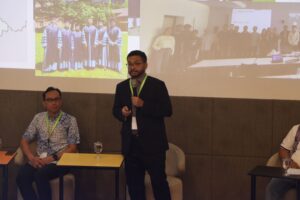
At the opening day of ICOBAR – FIDI Joint Scientific Forum 2025, Prof. Dr.-Ing. Hendro Wicaksono delivered a compelling keynote on how Indonesia can break free from the middle-income trap. Speaking from his experience as a researcher in Bremen, Germany, he emphasized that the nation’s economic future hinges on reindustrialization built on sustainability, digital transformation, and collaboration.
Prof. Wicaksono began by diagnosing the structural issues Indonesia faces: stagnant productivity, low research investment (0.3% of GDP), dependence on raw exports, and limited integration into global value chains. Unlike nations such as South Korea or Germany, Indonesia has yet to fully leverage R&D as an engine of growth.
His proposed vision of reindustrialization redefines manufacturing not as a return to old factories but as a transformation that embeds renewable energy, circular economy models, and advanced digital technologies like explainable AI and digital product passports. He stressed that sustainability is no longer optional:
“Sustainability is not just CSR. It is a new competitive advantage.”
Collaboration was another pillar of his talk. Drawing lessons from Germany, he illustrated how ecosystems of government, industry, SMEs, and universities can work together. German policy, he explained, enables risk-sharing in R&D by funding up to 50% of small company projects, while universities contribute applied research expertise. This fosters innovation without mandating rigid quotas.
Insights from the Q&A
During the discussion, a representative from Persatuan Insinyur Indonesia asked whether Germany has regulations requiring private companies to fund innovation—an approach some envision for Indonesia.
Prof. Wicaksono clarified that in Germany, there is no strict law obligating companies to conduct R&D. Instead, large firms naturally invest because innovation fuels their competitive edge. For SMEs, the government minimizes risk by co-funding projects and supporting collaboration with universities.
“There’s no strict rule that everyone must do research,” he explained. “The government stimulates innovation by helping smaller companies share the risk and by connecting them with universities.”
This model, he suggested, offers a useful reference for Indonesia: rather than forcing research investment, policies can encourage it through incentives, partnerships, and supportive ecosystems.
A Path Forward
Closing his session, Prof. Wicaksono urged Indonesian stakeholders to look beyond imitation and move toward genuine innovation leadership. “Innovation distinguishes leaders from followers,” he reminded the audience, encouraging a mindset shift that embraces complexity and change.
His message resonated as both a challenge and a roadmap: to cross the bridge from middle-income to high-income status, Indonesia must invest in knowledge, build trustful collaborations, and innovate with sustainability at its core.
#ICOBAR2025 #BINUSUniversity #Reindustrialization #Innovation #Sustainability #DigitalTransformation #ResearchEcosystem
Comments :