


ICOBAR – FIDI 2025 Highlight: Dr. Stijn Cornelis van Huis Explored AI’s Impact on Law and Society
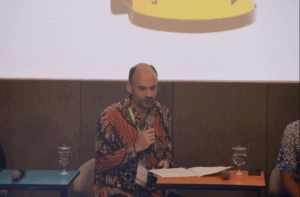
On the opening day of ICOBAR 2025, Dr. Stijn Cornelis van Huis delivered an insightful presentation on the concept of legal disruption in the era of artificial intelligence (AI). He began by defining disruption broadly as both societal upheavals caused by innovation and shifts in market dynamics, before focusing on how these changes directly affect the legal field.
According to Dr. Stijn, legal disruption occurs when traditional legal concepts are no longer sufficient to regulate emerging technologies. He illustrated this with examples such as liability in self-driving car accidents—should the driver or the manufacturer bear responsibility?—and the challenge of automated decision-making in courts, which raises questions of transparency, trust, and due process.
Drawing on research by Dutch scholars Jeroen Hopster and Guido Leurs, Dr. Stijn explained the levels of disruption:
- First-order disruption, which primarily affects markets;
- Second-order disruption, which impacts society at large (e.g., social media);
- Deep disruption, which challenges ethical principles and fundamental societal values.
In addressing these disruptions, Dr. Stijn proposed an analytical framework that combines legal, technological, and societal perspectives. He stressed the importance of evaluating whether issues can be resolved with technical solutions, self-regulation, or whether new legislation is necessary.
He also warned of the dangers of overreliance on AI in judicial contexts, emphasizing that while automated tools may aid simple cases, society still values human judgment and the right to be heard in court. Excessive reliance on AI could erode trust in the legal system—a profound example of deep disruption.
Dr. Stijn concluded by underscoring the need for careful, multidisciplinary approaches to regulate AI. “We must decide when technology requires new laws, when self-regulation suffices, and when legal concepts can be adapted,” he noted, before excusing himself to attend a personal family milestone.
#ICOBAR2025 #LegalDisruption #ArtificialIntelligence #AIandLaw #BinusUniversity #ResearchImpact
Comments :