

Non-STEM Research and the Product Commercialized PI — What BINUS Lecturers Need to Know
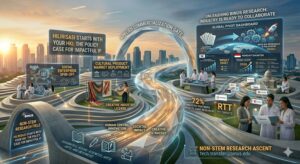
Walk into any BRIDGE Apps submission workshop and the room will trend heavily toward Computer Science, Engineering, and Information Technology. The pattern is consistent — not because lecturers from other disciplines lack applicable research, but because the majority of Design, Communication, Psychology, and Business faculty at BINUS operate under a quiet assumption that the Product Commercialized PI was built for someone else. That assumption is wrong, and it has a measurable cost every BKD cycle.
The PI Product Commercialized rubric does not specify a technology type. It specifies an output that has a defined non-BINUSIAN beneficiary, an associated HKI (Hak Kekayaan Intelektual — Intellectual Property Rights), and demonstrable readiness for adoption. A design methodology, a validated psychological assessment instrument, a communication training module, or a UX framework satisfies all of these conditions — and lecturers in DKV (Desain Komunikasi Visual), Psychology, Communication Studies, and Business who have not submitted are leaving a legitimate PI claim on the table each year.
The confusion often begins with the word “technology.” In the Indonesian research governance framework, the official definition of teknologi terapan (applied technology) is broad. Kemdiktisaintek’s 2025 Program Pendanaan Hilirisasi Riset explicitly listed “sosial humaniora, pendidikan, seni-budaya” — social humanities, education, arts, and culture — among its eight national priority focus areas, alongside engineering, health, and maritime sectors. This is not a footnote. It is the official scope of the hilirisasi framework, which BINUS RTT’s Product Commercialized PI mirrors. Non-STEM outputs are not accommodated at the margins — they are named as eligible research categories at the national level.
To make this concrete with a Psychology example: a lecturer who has developed and validated an emotional regulation intervention protocol for adolescents — tested with participants at a Tangerang community health centre — has a product. The protocol can be registered as a copyright (hak cipta). The health centre constitutes a non-BINUSIAN beneficiary. The validation report serves as technical documentation. A one-page note on adolescent mental health prevalence in urban Indonesia satisfies the market needs parameter. This product would score competitively on at least five of the eight rubric parameters — IP Ownership, TKT, Technical Documentation, Competitive Advantage, and Market Readiness — without any additional development work. Nothing is missing except the submission.
A DKV example is equally clear. A lecturer who has designed and field-tested a visual communication system for low-literacy public health messaging — commissioned by a district health office in West Java — has a stronger product case still. There is a defined institutional client, a documented implementation, and a real-world outcome. With an associated copyright on the visual system, the product clears the HKI, TKT, market readiness, and beneficiary parameters simultaneously. If the health office has formally adopted the system, the Industry/Investor Interest parameter (10% of the rubric) becomes claimable as well.
For Communication Studies and Business lecturers, the most common eligible product types are training modules, assessment toolkits, strategic frameworks, and digital platform concepts — each of which can be copyrighted and documented to the standard the BRIDGE Apps rubric requires. The key constraint is not the nature of the output but the quality of the documentation: TKT evidence (a pilot test or user validation study), a technical specification describing the product’s structure and intended use, and a market context note explaining who needs it and why existing alternatives are insufficient.
Evidence from peer institutions supports the case. Institut Teknologi Bandung’s LPIK (Lembaga Pengembangan Inovasi dan Kewirausahaan) reports that design and social science outputs represent a growing share of its registered innovations, partly because these products tend to have faster paths to adoption than hardware prototypes, and partly because their IP registration — typically copyright rather than patent — is simpler and faster to complete. The commercialization infrastructure does not need to be rebuilt for non-STEM disciplines; it already accommodates them. The bottleneck is awareness, not eligibility (ITB LPIK, 2023 — Laporan Tahunan Inovasi dan Kewirausahaan ITB).
Non-STEM BINUS lecturers who want to test whether their research output qualifies should begin with one question: is there a specific, non-BINUSIAN person or organisation whose real problem your research helps solve? If the answer is yes, the product case almost certainly exists. The next step is an RTT consultation — a session where a specialist maps your output against the eight rubric parameters and identifies exactly what documentation you still need to build.
For the full eligibility criteria, rubric breakdown, and submission process, visit the Product Commercialization page at BINUS Technology Transfer.
#nonSTEM #DKV #psikologi #komunikasi #B
INUSresearch #PIProductCommercialized #hilirisasi #risethumaniora
Comments :