


“Welcome to the jungle, you all fell into my trap.” He said. And that is how our trip to Sibandang began.
He said that 3 days ago before our departure day to Sibandang Island. He was not kidding when he said that. I mean – seriously, he trapped us all. I am not saying it is a bad trip, but it was an amazing trip indeed. I’ve spent my days completely fine and I enjoyed it so much. I’ve gained so much knowledge and had the opportunities to learn their culture and history of how the island
was formed.
Discovering the Hidden Pearl of Lake Toba
Sibandang Island or Pulo Sibandang, which was originally referred to in the local terminology of the people around Lake Toba as Pardopur Island, is a natural island situated within the southern waters of Lake Toba in Muara, North Tapanuli, North Sumatra. As the second-largest island in the lake after Samosir, it spans approximately 461 hectares and is designated as one of the 16 official geosites of the Toba Caldera UNESCO Global Geopark. Formed by the monumental supervolcanic eruption of Mount Toba roughly 74,000 years ago, it offers a quieter, more rural, and culturally rich alternative to the busier tourist hubs around the lake. The island comprises three main villages (Sibandang, Papande, and Sampuran) and populated by four major Batak clans: Ompusunggu, Rajagukguk, Simaremare, and Siregar. The island is famously nicknamed ‘Mango Island’ due to its massive production of Mangga Udang (shrimp mangoes), a sweet, small variety originally brought by the Dutch. As for Papande Village, they are known for their traditional hand-woven textile, Ulos. Ulos (properly known as Kain Ulos) is the traditional, hand-woven textile of the Batak people of North Sumatra. More than just a piece of clothing, it is a sacred cultural symbol that represents status, love, warmth, and divine protection. In Batak culture, Ulos plays a central role in every major life milestone, from birth and weddings to funerals.
Day 1: The Gateway at Muara
Our 4-day, 3-night journey was an immersive cultural and agro-tourism experience. Day one was the day we began our journey from Medan along the Sumatran coastline to Muara. On the first day, we didn’t do much, but rather prepared ourselves for the next day, where we would begin our first day on Sibandang Island. We stayed at a fairly well-known hotel in Muara called Libra Hotel, which coincidentally was also close to Muara harbor, facing the island just across the water, Sibandang Island. It only took us a five-minute walk from the hotel to the harbor. On our first night, after unpacking our things and having dinner, we gathered in a small hall at the hotel for tomorrow’s briefing. That was when we finally met Bang Switno Rajaguguk, the head of the local tourism awareness group (Pokdarwis), who would be our tour guide during our time on Sibandang Island. What makes Bang Switno so inspiring is his background that he graduated from the Faculty of Cultural Sciences at USU, but his heart remained with his hometown. He made the choice to return to the island to promote, develop his own village and dedicate himself to putting Sibandang on the tourism map. Even though our first meeting was brief—since it was already 9 PM and Bang Switno had to head home for other activities—we wrapped up the meeting once everything was settled. We went over the rundown, the local do’s and don’ts, and how to properly greet and blend in with the locals. I remember him vividly saying, ‘When you greet the mothers there, call them Inang or Nangboru. If you meet the men, you can call them Amang or Amangboru. And when we hike up the hill tomorrow, if you have any trash, do not litter. Keep it with you, and we will dispose of it properly later.’ He also taught us the sacred Batak greeting, ‘Horas!’—a powerful word used to welcome people, say goodbye, and wish each other good health and safety. Despite the short encounter, it left us incredibly excited and looking forward to tomorrow’s journey.
Day 2: Conquering Peaks and Meeting Pure Hearts
Morning came and our trip continued. It was the second day of our journey in Pulo Sibandang. We started our morning by having breakfast at the hotel. Once we finished, we went back to the room, packed our things, and headed straight to the harbor to catch the ferry. The morning sun was shining beautifully over the water, and we could see the green silhouette of Sibandang Island waiting for us just across the lake.
Our ferry finally pulled up, and we hopped on. Once we stepped foot on the island, Bang Switno warmly welcomed us back, ready to start the day’s activities. He gathered everyone around a large map signboard located right at the harbor. At the Muara Sibandang harbor, there was a signboard showing a map of the island. Pointing at the map, Bang Switno shared fascinating facts about Sibandang, pointing out where the three villages are located.
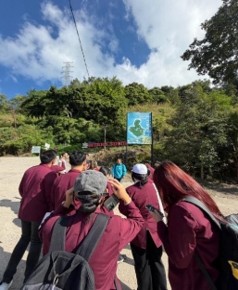
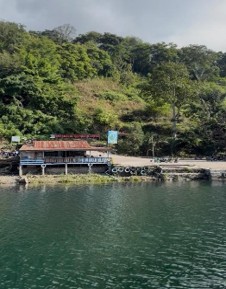
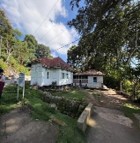
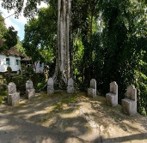
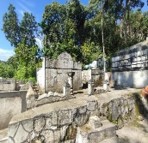
With the introduction complete, we began our journey by walking towards Sibandang Village to visit the local hall. To reach the village hall, we walked past rows of local houses while Bang Switno continued to share fascinating insights about the island. Our walk brought us to a halt in front of a famous historical site: the tomb of Raja Rajagukguk. The burial complex belongs not only to the king himself but also to his wives, children, and descendants. Right in front of the king’s tomb, there are seven ancient stone chairs (Batu Kursi). Historically, these stones served as a sacred assembly point where the king and his royal council held meetings and made important decisions for the kingdom. Right next to these seven stone chairs stands an old wooden house.
Bang Switno explained that during the Dutch colonial era, this building served as the central government office, known locally as the Kantor Kepala Nagari (the village chief’s office).
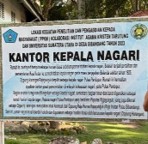
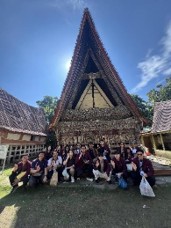
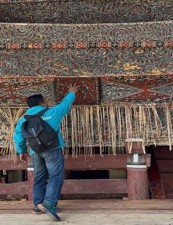
After that, we continued our walk, weaving past more local houses until we arrived at a majestic traditional Batak house called Ruma Bolon. Historically, Ruma Bolon—which translates to ‘Big House’—was the official residence of the Batak kings. Built as a wooden house on stilts without using a single nail, its iconic high, curved roof resembles the horns of a buffalo, symbolizing strength and protection for the community. It was not just a home, but also a sacred space where the king lived, preserved tribal values, and hosted royal guests. As we stood admiring the building, Bang Switno pointed toward the intricate carvings on the wooden walls and shared, “This Ruma Bolon was once the home of the kings. Look closely at these traditional carvings—we call them Gorga. The presence of Gorga on the walls is the ultimate symbol showing that the owner of this house was indeed a king.”
Empowering the Community: The BINUS Workshop
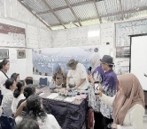
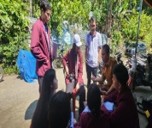
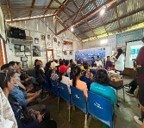
After the fascinating lesson at Ruma Bolon, we finally arrived at the village hall. There, a warm crowd of locals was already waiting. They were attending a training workshop organized by BINUS Jakarta and Medan. The hospitality we received was incredible; the villagers welcomed us with open arms and bright smiles. While the workshop sessions were conducted directly by our lecturers, we, students, had our own special mission: to distribute surveys and gather feedback from the residents. This gave us a wonderful opportunity to have genuine conversations and truly blend in with the community. We learned so much about how they live, work, and go about their daily routines. It was eye-opening to see how deeply they protect the nature that sustains them, how harmoniously they live side-by-side, and how their rich cultural traditions remain tightly woven into their modern daily lives. More importantly, we witnessed the positive changes they experienced through this training. The optimism of the villagers was nothing short of amazing. The youth were bursting with enthusiasm to develop and advance the villages on Sibandang Island, and even the elders actively participated, bringing so much energy to the session. A tangible success story from this workshop came from Chef Trias, a Hotel Management lecturer from BINUS Jakarta. He led a culinary training session utilizing the island’s abundant natural resources: mangoes, coffee, and cacao. Together, they created a unique candy called ‘Chofeego’—a brilliant fusion of chocolate, coffee, and mango. When you take a bite, you experience all three flavors: a rich chocolate outer layer, a crispy texture from coffee beans inside, and a burst of sweet mango jelly at the center. The local mothers successfully mastered the recipe and have even started experimenting on their own! One local shared a proud status at WhatsApp saying: “A fusion of chocolate, peanuts, and mango! I immediately practiced what I learned from BINUS University at home. Since the coffee beans weren’t ready yet, I substituted them with peanuts, and it turned out so delicious! Feel free to try it.” They named this creative variation as ‘Chocanggo’. From this beautiful encounter, we realized that the people of Sibandang Island possess boundless creativity and a strong sense of optimism. They are not just passive hosts; they are deeply driven to innovate and elevate their own local tourism.

The Puncak Natissuk “Trap”
And now I’m going to tell you why I told you at the very beginning that we had all fallen into his trap. After wrapping up the BINUS training workshop at the village hall, we packed our gear and prepared to head toward Natissuk Peak (Puncak Natissuk)—the highest point on Sibandang Island. Now, let me be completely honest with you: I am not kidding, friends, that was the most exhausting walk I have ever encountered! Before we left, they casually told us that reaching Natissuk Peak was an easy breeze and the trail was simple. But let me tell you the truth: it was not! What they said did not match my expectations, nor my friends’ at all. We thought the Journey up the hill would be effortless, especially knowing that BINUS had actually built a concrete path to make the hike to Natissuk Peak more accessible.
But boy, were we wrong. The path is actually in great shape, but because it is a continuous, steep incline, it completely drained our energy! The toughest part—the real ‘mountain-climbing’ struggle—hit us as we got closer to the peak. The concrete road ended, and we had to navigate our way directly through local dry agricultural fields and dry, tall grasses. Yet, despite how challenging it was, it was absolutely worth the hike. Throughout the climb, we were treated to breathtaking scenery at every turn. The air was incredibly fresh and clean, offering us stunning panoramic views of Lake Toba’s sparkling waters below. Along the way, local farmers passing by warmly called out to us, giving us encouraging smiles and friendly greetings to keep us going. I don’t regret a single step of that climb. In fact, I am incredibly grateful that I pushed through my limit, endured the steep climb, and finally stood at the summit. Looking down at the vast, magnificent view of Lake Toba from the very top of the island was a moment of pure magic. It taught me that sometimes, the hardest climbs yield the most beautiful rewards.
After pushing through so many challenges, we finally reached the top. Well, physically, we actually only made it to the second checkpoint. Bang Switno casually mentioned that there were six more checkpoints to go! Hearing that, we were all completely shocked and immediately ‘waved our white flags’ to signal our surrender. We decided to end our hike right there because we were already exhausted. But honestly, it was not disappointing at all. The view from this second checkpoint was absolutely marvelous. I was completely stunned by the breathtaking panorama after such a challenging climb. What made the hike even more memorable and enjoyable was that some of the locals actually climbed up with us!
Standing there together, we took so many amazing photos and had the best time. Then, there came a moment that I will cherish forever. We all gathered and formed a large circle to record a video. Chef Trias stood right in the center, proudly waving the Indonesian red-and-white flag (Bendera Merah Putih), as we sang our national songs. Holding hands with the locals, our voices echoed across the hills. I remember turning to my friend next to me and whispering, ‘My sense of nationalism is growing so much stronger up here.’ To my left was one of the local mothers who had hiked up with us. I was completely in awe of her—she knew every single lyric of the songs we sang and chanted them with such a loud, proud voice. Afterward, we even played a game where we held hands and created a human wave, just like football fans do in a stadium. In that moment, surrounded by the beauty of Toba and the warmth of the people, we were truly one. We enjoyed every single second of it.
A Heartwarming Encounter
By the time the clock struck 5:00 PM, we decided to wrap up our mountain adventure and head back down. My friends and I had assumed that going down would be much easier than the climb up—and once again, we were proven wrong! Descending the steep slope presented its own set of challenges, though at least it didn’t drain our energy as rapidly as the ascent. As we made our way down, we were treated to an entirely new perspective of the island’s beauty. The late afternoon sun was beginning to soften, casting a warm, golden glow over the vast expanse of Lake Toba. The green hills looked incredibly serene under the fading light, and the shimmering water below looked like a mirror reflecting the evening sky. It was a breath-taking, cinematic sight that made us pause and just admire the view.
The trek down to the village hall took us only about thirty minutes. By the time we arrived, everyone was visibly exhausted. Some of us immediately sat down to catch our breath and rest. I decided to sit just across from the village hall, resting on some natural stone steps. It was during this quiet moment that I met two incredibly sweet and cute local kids named Cian and Abi. They are siblings, and as it turned out, their home was just right next to the village hall.
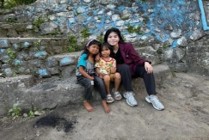
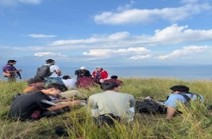
They had actually been keeping an eye on me from the very moment I first stepped foot in Sibandang Village. They were just too shy to approach me at first, and only built up the courage to come over once I waved and called them over for a chat. Just as I had mentioned, they were such sweet, cute kids. And just like how I had blended in with the older locals earlier, I did the same with them—though, of course, in a much gentler, playful way since I was talking to children. We started with the classic icebreakers that any strangers use to get to know one another: asking for their names, their ages, what grade they were in, and how their day was going. We ended up talking about so many things, and through our chat, I got a heart-warming glimpse into the daily routines of the kids in this village. They love playing classic games like Play tag (kejar-kejaran) around the neighbourhood. But their absolute favorited part of the day comes in the late afternoon. As the sun begins to set, all the village kids gather by the lakeside to splash around, swim, and just have pure, simple fun in the fresh waters of Lake Toba. Hearing them talk about their simple lives made me realize how beautiful and peaceful childhood is on this island.
Saying goodbye to Abi and Cian was hard, but we can’t stay any longer as the sky began to darken, we had to gather our things and head back to the harbor. Our ferry was waiting, ready to take us back to our hotel in Muara. As the ferry pulled away from the shores of Sibandang Island, I looked back at the green hills we had just climbed. The cool evening breeze of Lake Toba washed over us, carrying away all of our physical exhaustion. Watching the twilight settle over the water was incredibly peaceful. We arrived back at the Libra Hotel tired, sore, and with dusty shoes—but our hearts were absolutely full. In just one single day, we had learned about ancient Batak kings, witnessed the incredible creativity of the local mothers with their Chocanggo experiments, stood at the top of Natissuk Peak singing our national anthem hand-in-hand with the community, and made sweet new friends. It was only our second day, but we already felt like we belonged. We fell fast asleep that night, eager to see what the next two days of our journey would bring.
Day 3: Threads of Heritage and Lakeside Harmony
On the third day, we set off to Papande Village, the second village on Pulo Sibandang. Since Papande is highly famous for its traditional weaving, our main goal for the day was to visit the local weavers’ homes. Bang Switno had mentioned that almost 90% of the women on this island are skilled Ulos artisans. Unlike the previous day, we didn’t have to wake up as early, allowing us to have a more relaxed morning. Once we crossed over and arrived at the harbor on Sibandang Island, we took a quick break at a cozy little lakeside stall (warung). Just like any typical Indonesian warung, they served coffee, snacks, and of course, Indomie. I heard their Indomie is exceptionally delicious, though unfortunately, I didn’t get the chance to try it. Because this little stall sat right on the edge of the lake, we were treated to an absolutely breath-taking, cinematic view looking back toward Muara. I am not even exaggerating—the scenery was incredibly stunning. The vast, deep blue water of Lake Toba stretched out endlessly before us, meeting the towering, majestic green cliffs of the caldera in the distance. The water was so calm and crystal clear that it looked like glass so much that we could actually see the fish swimming right beneath the surface. The gentle morning breeze carrying the faint scent of freshwater made the whole moment feel like a peaceful dream. Once everyone was ready and our local guides—two warm and friendly local mothers (akamsi) who would guide us to the weavers’ homes—had arrived, we finally left the warung to continue our journey to Papande Village.
Since Papande is much further away than Sibandang Village and too far to reach entirely on foot for everyone, our group was split into two. One group went on foot accompanied by one of the mothers, while the other group took a car with the second mother. I was in the car group, so I didn’t get to experience the walking trail first-hand. However, riding in the car gave me a completely different, wonderful experience. Sitting right by the window with the glass rolled down, I felt the cool, refreshing island breeze rushing against my face. As the car rolled along the quiet roads, we were surrounded by lush, untouched green forests on one side and charming, traditional village houses on the other. It was incredibly peaceful, capturing the raw, rustic, and authentic beauty of island life.
Inside the Weavers’ Sanctuary
After a scenic ride, our car pulled up in front of a simple brick house. As we stepped inside, we were welcomed into a cozy, tiled room where a local mother wearing glasses and her teenage daughter were working closely together on a floor loom. As we watched them, we learned a fascinating detail: making this traditional Ulos is actually a two-person job. Sitting right opposite each other on the same wooden frame, their movements were perfectly synchronized. The mother’s hands moved with practiced ease and precision, while her daughter worked in unison to guide and tighten the threads, ensuring the weave remained strong and flawless. We stood in awe watching the vibrant blue and white threads slowly transform into intricate geometric patterns through their teamwork. Even though they were working in a simple corner of their home, their dedication to preserving this craft was incredibly inspiring.
As they worked, the mother kindly explained the deep cultural meaning behind the fabric. I remembered what we had learned earlier: that in Batak culture, Ulos is far more than just a piece of clothing. It is a sacred symbol of status, love, warmth, and divine protection, used to mark major life milestones from birth to marriage and final farewells. Standing in that quiet room, witnessing the beautiful teamwork between mother and daughter, felt incredibly intimate. It was a perfect, real-life picture of how local traditions are not just talked about, but actively lived and lovingly passed down from one generation to the next in the comfort of a family home.
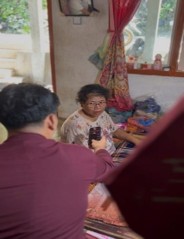
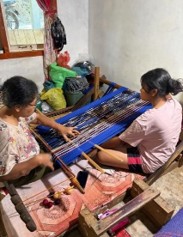
As we observed them weave, we asked more about the rules of wearing Ulos. Interestingly, the artisan mother and our tour guide dispelled a common misconception for us. They explained that there is actually no strict rule dictating exactly which type of Ulos one must wear for specific events, such as weddings. Instead, the tradition is much more practical. The main distinction lies in the tone of the fabric; when attending a funeral, the only key custom they follow is simply to wear an Ulos with darker tones to reflect the solemnity of the occasion.
The mother also shared an insider’s look into the quality of the fabrics. She explained that Ulos is generally divided into two types based on the materials used: those made with chemical-based dyes and those crafted from 100% natural ingredients. Naturally, the ones made with natural dyes are significantly more expensive than the chemical ones, and it all comes down to the process. Extracting colors from nature requires a much more complex, delicate, and time-consuming method. She told us that even for a skilled artisan, it takes up to four whole days of intense, focused work just to complete a single Ulos from start to finish. Learning this firsthand from the locals felt like uncovering a hidden piece of wisdom. It showed us that while their traditions are deeply respected, they are also beautifully practical, and every single thread carries a story of immense patience and hard work.
Instead of visiting another artisan’s home, we immediately continued our journey to the local Ulos Gallery. The gallery itself was a charming, modest little house, but inside, it was packed with the incredible creations of the village’s weavers. The room was filled with a rich variety of fabrics, ranging from contemporary stoles (stola) to the iconic, vibrant red Ulos traditionally worn for weddings. Being in that space gave us so many new insights into the art of Ulos and a deeper understanding of the weavers’ daily lives.
During our visit, the locals shared a fascinating fact that left us in awe: Papande Village is actually the heart of Ulos weaving, supplying fabrics across the entire Batak Toba region! They told us that if someone needs a specific or unique design for a special occasion, they can simply make a request, and the local artisans will custom-craft it directly for them. Stepping out of the gallery, I realized that this small village is quietly weaving the cultural fabric of the entire region, keeping an ancient heritage alive one customized thread at a time. After wrapping up our time at the gallery, we headed back to the lakeside stall (warung) where we had stopped earlier, this time for lunch. There was something incredibly peaceful about sitting by the water, looking out at the stunning view of Muara while enjoying a simple, hearty meal. It was the perfect way to recharge our energy after a morning full of cultural discoveries. Once our bellies were full and we were well-rested, we packed up our things, and set off once again to continue our journey back to Sibandang Village.
Fieldwork Interviews and Sport Tourism
Upon returning to Sibandang Village, we headed straight to the village hall (balai desa) again. Some of the locals were still in the middle of a training session, so we waited patiently for them to finish. Our main task for the afternoon was to interview the local residents to gather their impressions, thoughts, and feedback regarding the training program. Since this assignment required us to work in pairs, I joined forces with Irena, a fellow student from a different major. Instead of interviewing an adult, we decided to interview a familiar face—Viona, one of the local teenagers who had warmly accompanied us during our hike up the hill the day before!
To make the interview comfortable and visually scenic, we looked around for the perfect spot and found a beautiful area right by the lake, tucked just behind the houses of the local residents. With the calm water as our backdrop, we divided our roles: Irena took charge of asking the questions, while I focused on filming and capturing the whole conversation on video. Once all the student pairs had successfully finished interviewing the various local residents, we head back to the village hall again. Onto the next agenda, Bang Switno invited us to his house for some sport tourism, which included cycling around the village and kayaking on the lake. As soon as we arrived, we were greeted by a warehouse full of bicycles. Bang Switno began wheeling them out, and our group was split into two: one group would go cycling first, while the other would try kayaking, with plans to switch later. I was assigned to the kayaking group first. Unfortunately, by the time we finished, darkness was already creeping in, so I never got the chance to ride the bikes. Interestingly, the kayaks were kept in a completely different area. Bang Switno stored them in a handmade shelter attached to his livestock farm, surrounded by the lively sounds of ducks, chickens, and dogs. The ultimate highlight of the farm, however, was a pair of incredibly adorable puppies sleeping inside a large bucket—they were absolutely heartwarming!
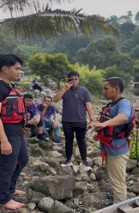
To get the water activities started, the heavy kayaks had to be hauled out. A local teenager, who we assumed was a relative of Bang Switno, helped pull them out with the assistance of two students and two lecturers. Once the kayaks were safely lined up by the lake, we gathered around for a quick briefing. Being the only expert here, Bang Switno gave us clear instructions on how to balance and paddle, emphasizing one crucial golden rule: stay calm, and do not panic or scream. He then explained that there were two types of kayaks available: a single-passenger version for the pros, and a double-passenger version for beginners. Since none of us had ever gone kayaking before, we all opted for the double kayak, with Bang Switno sitting in the back to safely steer and guide us. Even our lecturers couldn’t resist the temptation; driven by curiosity, several of them took turns trying it out, though not everyone got a turn due to personal preference and limited time.
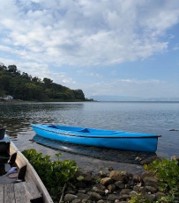
While we were waiting for our turns, we had the absolute joy of watching the local children playing by the water. Most of them couldn’t have been older than ten years old. They treated the edge of the lake like their own personal swimming pool—swimming, laughing, and splashing around. Some of the boys and girls even used a massive, natural fallen log as a diving board, fearlessly using the thick wood to launch themselves into the deep blue water. As we stood there enjoying their laughter, another young boy waded right past us, completely focused on diving down to look for fresh clams beneath the surface. It was such a pure, beautiful sight to witness.
Finally, my turn arrived! When I finally stepped into the kayak and felt it rock slightly on the water, a rush of nervous excitement washed over me. But the moment we pushed off the shore and started paddling, all my worries completely vanished. Seriously, everyone needs to experience the sensation of gliding across the water like that! The feeling of the cool breeze on your face while rhythmic paddling pushes you forward is something you truly have to feel for yourself. Fortunately, we had Bang Switno at the back as our reliable captain, making the entire ride feel completely safe and effortless.
It was one of those rare, magical moments where you just look around at the vast lake and think, ‘Wow, I am actually doing this.’ While kayaking with Bang Switno, I genuinely had the best time of my life. It was an absolutely thrilling experience. Alongside our unforgettable interaction with Cian and Abi the day before, this kayaking adventure is definitely a core memory that I will cherish for the rest of my life.

A Bittersweet Farewell
Although the sun hadn’t fully set yet, the afternoon was winding down, and it was time for us to pack up and head back to our hotel. To reach the harbor, we had to retrace our steps on foot, walking past the village hall and through the heart of the local neighborhoods. Since it was late afternoon, the village had come alive with children stepping out to play. As we walked, we witnessed local boys happily playing football in the open yards right in front of their homes—a simple, heartwarming scene of village life. But the most memorable moment happened just as we passed a small local stall (warung), and by a wonderful stroke of luck, Cian was there alongside another child named Lia, who was around her age, picking out some snacks. The moment Cian spotted me, she waved and shouted,
‘Bye, Kak Joce!’
Hearing her innocent voice call out my nickname instantly sent a wave of warmth through me, accompanied by a rush of mixed feelings. I smiled and said my goodbyes to her, too. Our farewell wasn’t a formal or dramatic one, and a part of me felt a pang of quiet sadness, knowing that Cian probably had no idea I wouldn’t be returning tomorrow. It made me realize just how deeply rooted my connection with these local children had become in such a short time; they weren’t just faces I met on a trip, but beautiful souls who had genuinely welcomed me into their world. That final, spontaneous goodbye is a memory I know I will never forget, and I can only secretly hope that somewhere in her heart, Cian won’t forget about me either. With those bittersweet thoughts, we continued our walk to the harbor, caught the ferry one last time, and officially brought our unforgettable third day to a close.
As the ferry pulled away from the harbor, the twilight began to settle in, wrapping the lake in soft, evening shadows. Realizing that this was our final ferry ride of the trip, we decided to make the absolute most of every remaining minute. For the very first time since the journey began, our entire group gathered together to take a group photo! Looking back, it was funny to remember how awkward we all were around each other at the beginning of the trip. But standing on the deck that evening, all of that hesitation had completely vanished. The shared laughs, the steep climbs, and the unforgettable moments had truly brought us together. We spent the rest of the ride taking photo after photo, capturing our smiles against the fading light, determined to freeze these last precious moments of unity before our journey officially came to an end.
Day 4: Heading Home to Medan
Finally, our journey to Sibandang Island officially came to an end. Day four marked the beginning of our trip back to reality—leaving the serene shores of Lake Toba behind and heading back home to Medan. We woke up that morning with a mixture of exhaustion and immensegratitude. As our vehicle finally hit the road and rolled away from the mountains, I looked out the window, watching the green landscapes slowly fade into the distance. The physical tiredness was real, but our hearts were completely full. We returned to the city physically drained but with hearts full of stories, a camera roll packed with shared smiles, and a beautiful bond that transformed a group of awkward, different-major students into a real team. Sibandang had given us an unforgettable adventure, and we were bringing a piece of its magic back home with us.
Conclusion and Acknowledgment
This field study to Sibandang Island has been an invaluable academic and cultural endeavor. Beyond achieving its primary objective of assessing local training outcomes and documenting indigenous heritage, the journey provided profound insights into regional community dynamics, sustainable local industries, and the enduring strength of Batak Toba traditions. We extend our highest appreciation to the local government and the residents of both Sibandang and Papande for their exceptional hospitality and openness during our research. Special thanks are due to the local artisans who graciously shared their expertise on traditional Ulos weaving, as well as the local youth and children—particularly Viona, Lia, Abi, and Cian—whose presence added immense value to our cultural immersion. We also express our sincere gratitude to Mr. Switno Rajagukguk for his invaluable logistical guidance and technical leadership during our sport tourism activities, and to our dedicated faculty supervisors for their continuous support and academic mentorship throughout the program. Finally, this interdisciplinary field trip successfully fostered strong collaboration among students from various majors. While our team initially came together as individuals from different academic backgrounds, the challenges and experiences shared throughout these four days ultimately forged a highly cohesive and united group. The field activity has formally concluded, but the data gathered, the practical experience gained, and the professional bonds established will serve as a strong foundation for our future academic pursuits.