Title
When AI Sneezes, Does Asia Catch a Cold?
Category
Case Study & Document
Description
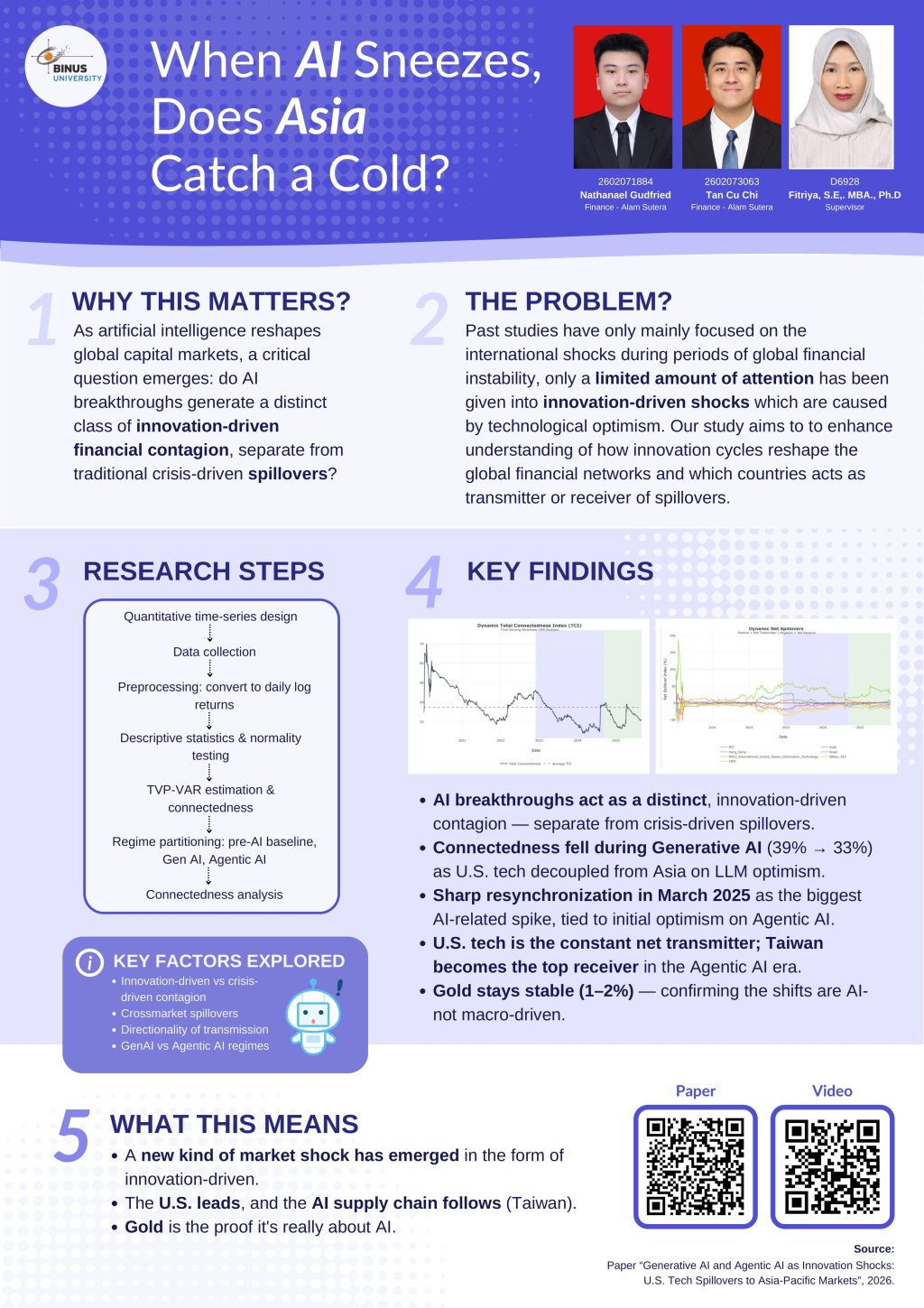
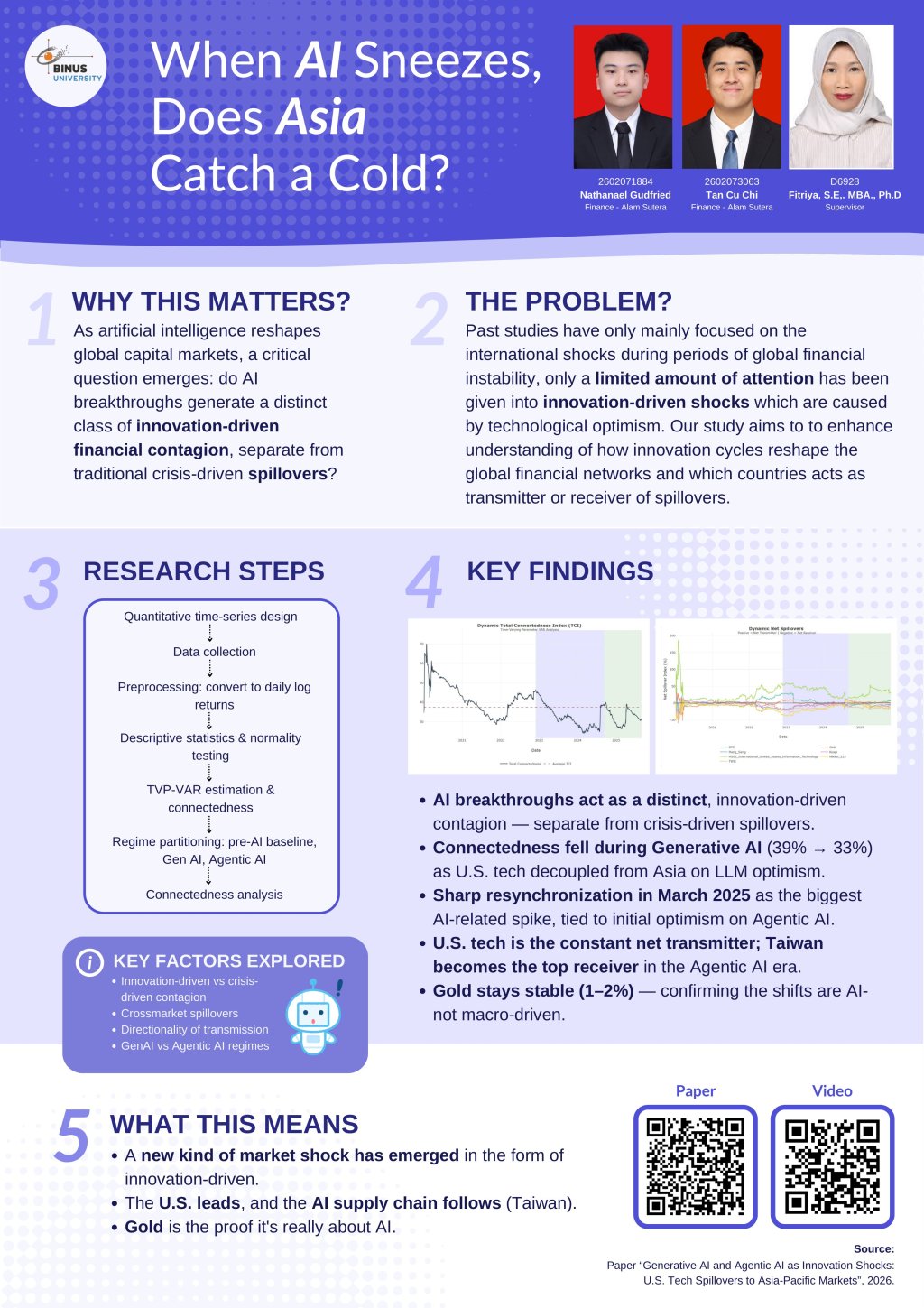
The rapid advancement of artificial intelligence (AI) has introduced a new source of uncertainty and opportunity in global financial markets. While previous research has primarily examined cross-market contagion during financial crises, relatively little attention has been given to innovation-driven spillovers resulting from major technological breakthroughs. This study investigates whether the emergence of generative AI and agentic AI has created a distinct form of financial contagion and how these developments influence the transmission of shocks from the U.S. technology sector to Asia-Pacific equity markets. Using a quantitative time-series approach, the study analyzes daily market data across three distinct periods: the pre-AI baseline, the generative AI era, and the agentic AI era. After converting price data into daily log returns, the research employs a time-varying parameter vector autoregression (TVP-VAR) model to estimate dynamic connectedness and identify the direction and intensity of cross-market spillovers. The findings reveal that AI breakthroughs generate innovation-driven contagion that differs from traditional crisis-induced market shocks. Market connectedness declined during the generative AI period, reflecting temporary decoupling between U.S. technology stocks and Asia-Pacific markets driven by optimism surrounding large language models. However, the emergence of Agentic AI triggered a sharp resynchronization of global markets, with U.S. technology stocks remaining the primary transmitter of shocks and Taiwan becoming the largest receiver due to its central role in the AI semiconductor supply chain. These results provide new evidence that technological innovation has become an independent driver of global financial interconnectedness, offering valuable insights for investors, policymakers, and risk managers navigating the evolving AI economy.
Contact Us
km@binus.edu