Title
Can Green Innovation Protect Firm Value from Carbon Risks?
Category
Case Study & Document
Description
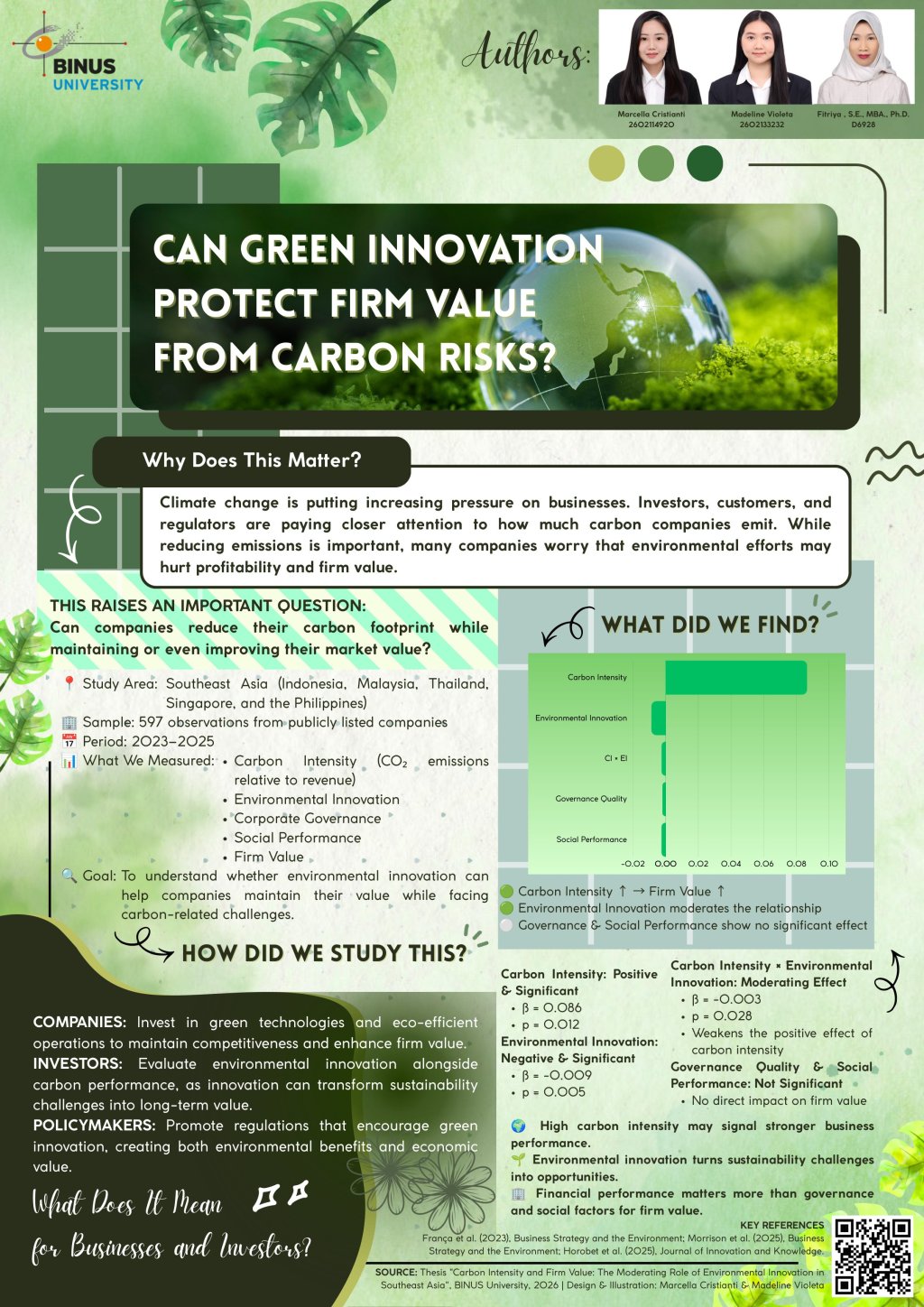
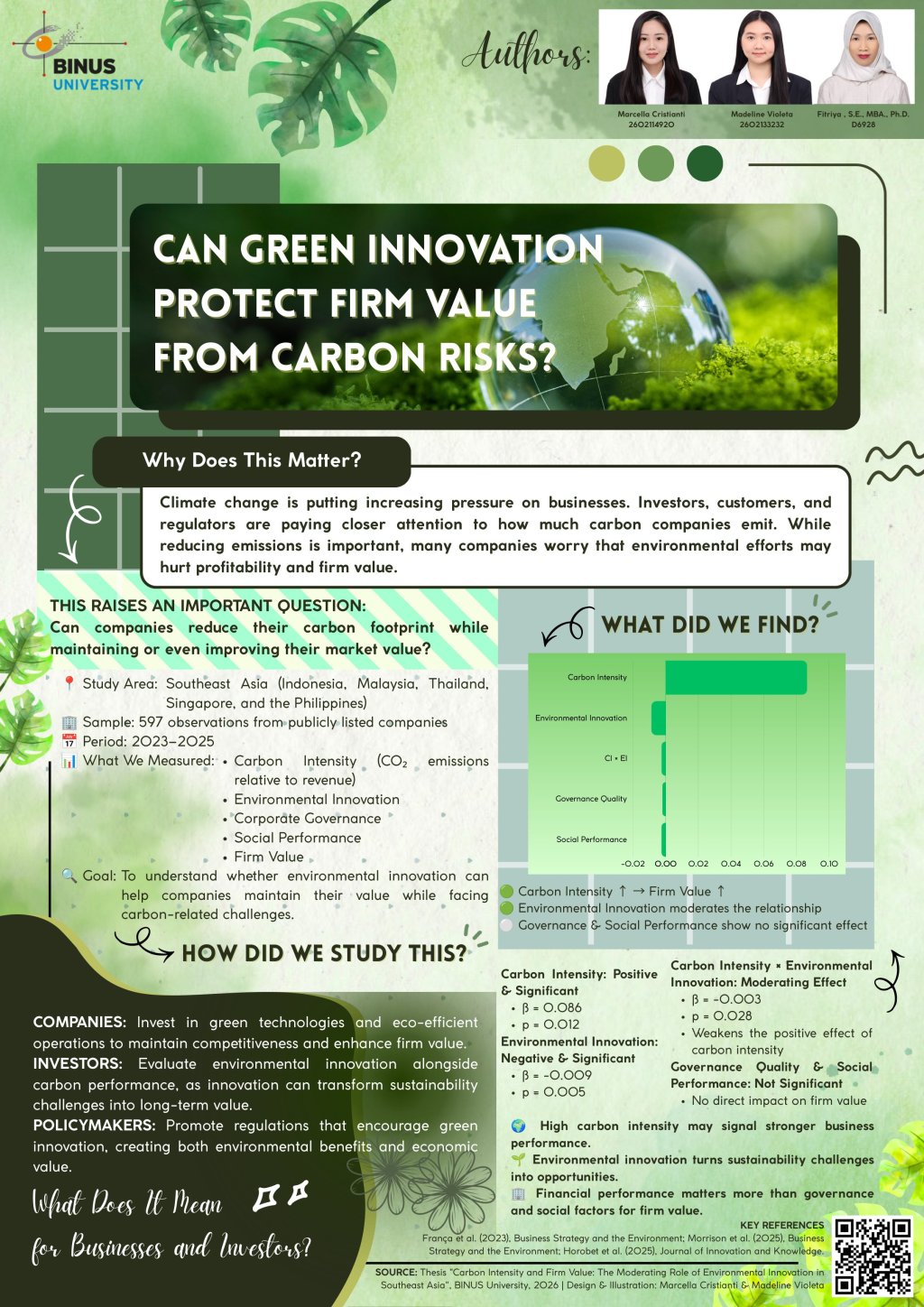
Climate change has intensified the need for businesses to balance environmental responsibility with financial performance. While reducing carbon emissions has become a strategic priority, companies often face concerns that sustainability initiatives may compromise profitability and market value. This study investigates whether environmental innovation can mitigate the potential impact of carbon-related risks on firm value among publicly listed companies in Southeast Asia. Using a sample of 597 firm-year observations from Indonesia, Malaysia, Thailand, Singapore, and the Philippines during 2023–2025, the study examines the relationships among carbon intensity, environmental innovation, corporate governance, social performance, and firm value. Multiple regression analysis reveals that carbon intensity has a positive and significant association with firm value, suggesting that firms with higher operational intensity may also exhibit stronger financial performance. However, environmental innovation demonstrates a significant moderating effect by weakening the positive relationship between carbon intensity and firm value, indicating that green innovation enables firms to sustain value while transitioning toward more environmentally responsible operations. In contrast, corporate governance quality and social performance do not show significant direct effects on firm value. The findings highlight the strategic importance of investing in environmentally innovative technologies and sustainable business practices. Rather than viewing sustainability as a financial burden, firms can leverage environmental innovation to transform carbon-related challenges into long-term competitive advantages. The study provides valuable implications for corporate managers, investors, and policymakers seeking to promote sustainable growth while maintaining economic performance in emerging Southeast Asian markets.
Contact Us
km@binus.edu